When I started getting interested in our family history, the logical first stop was talking to my mother Marian, the only person who knew most of the story. During those talks, she would occasionally mention that one of our relatives on my father’s side of the family had been killed by “chicken thieves” in a town called Silt in Colorado. As the years went by and I started to write about our history, I kept wondering about this story. Was one of our family really killed by chicken thieves? Spoiler alert – YES (although it’s not clear they were after chickens).
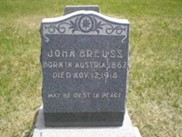
My curiosity finally took over, and I stated a more detailed research effort focused on the family of my fraternal grandmother Kreszentia Bruess Lang. The breakthrough came via “Find A Gravestone” on Ancestry where I found the gravestone of my grandmother’s brother, Johann Bruess, in Rosebud Cemetery in Glenwood Springs, Colorado. With no further clues on Ancestry as to what happened to him, I decided to actually go to Glenwood Springs and Silt to see if there were records.
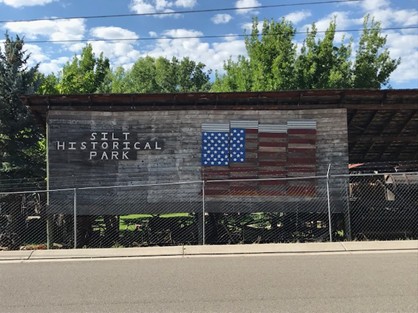
Glenwood Springs, Colorado, a spa town featuring mineral hot springs, is the seat of Garfield County with a population of about 10,500 people. Staying there, Leslie and I found Rosebud Cemetery and the gravestone of my relative John Bruess. Venturing 15 miles further west on Interstate 70, we visited the small town of Silt. It seemed to be mostly farms and ranches but there was a small building with some old artifacts to see. We also found a small library, which unfortunately was closed.
Back in Glenwood Springs, I found the library phone number and called the next day. Asking about old newspaper articles that would mention thieves and a murder, the librarian told me to call the Glenwood library because all Garfield County libraries are tied into the same set of archives, and they might have someone who could help with my request. The woman who answered my call was amazed at my story and said she would do some research. She was more amazed, and I was thrilled when she called back, having found numerous newspaper articles that provided the full story of John’s demise. Here it is along with some background.
Johann Bruess Jr., known as John here in America, came to the United States in the 1890s with his father Johann and his sisters Rosa and Kreszentia. At their first real stop, Philadelphia, Rosa met John Waldis, married him and went to live with him in Roanoke, Virginia. Her father, Johann, accompanied them and lived out his life there. Kreszentia, not wanting to be a third or fourth wheel in Roanoke, moved to Chicago to join her cousins. Johann Jr. headed west to seek his fortune.
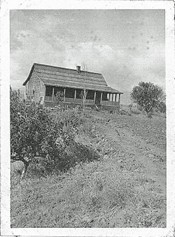
We have no information on why he chose Colorado or why he wanted to own a ranch, but the county title abstracts show that he purchased the ranch in 1910 for a very modest price. From the ongoing land records, we can also tell he was pretty shrew businessperson. In fact, he was later described in a newspaper account as a wealthy ranch owner in the small farming town of Silt in Garfield County. We also know that, unfortunately, John went missing in the middle of November 1918.
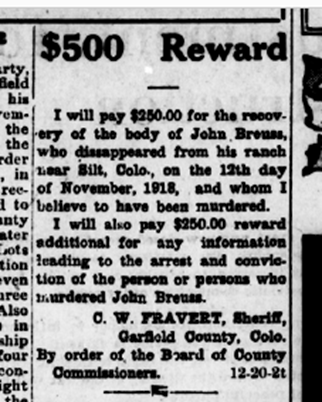
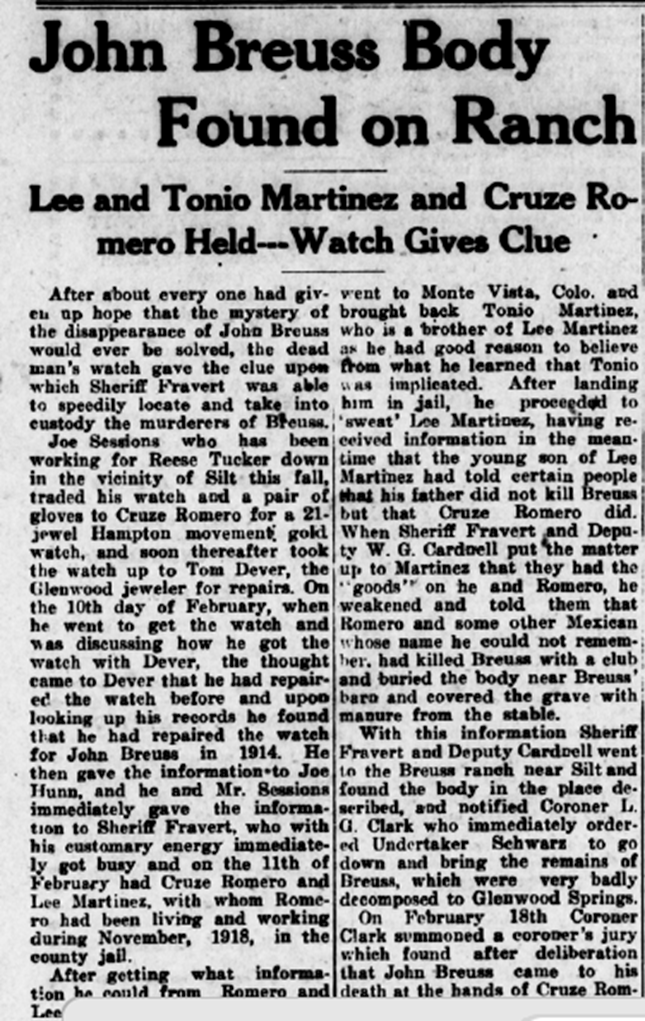
As shown in the newspaper article below, Sherrif C. W. Fravert suspected foul play and offered a $500 reward for the recovery of John’s body and information leading to the arrest and conviction of the persons who murdered him.
The case stalled until the 10th of February 1919 when a man named Joe Sessions who had been working in the vicinity of Silt, walked into the jewelry store in Glenwood Springs seeking repairs on 21-jewel gold watch he had just acquired. After asking how the man came by the watch, Tom Dever, the jeweler, recognized it as one he had repaired five years earlier. Looking up his records, Mr. Dever found that the watch had belonged to John Breuss. The two men, aware of the John Breuss case, gave the information to Sherrif Fravert who promptly arrested the perpetrators. From one of those arrested, the sheriff learned that the others had killed John with a club and buried him under a pile of manure near his barn. The coroner recovered the remains which are now buried in Rosebud Cemetery at Glenwood Springs.
THE REST OF THE STORY
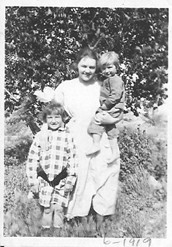
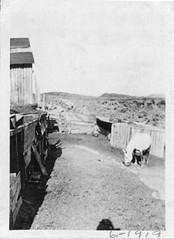
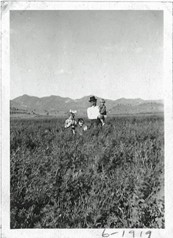
In the months following the discovery and internment of John’s remains, county authorities set about dealing with the disposition of his estate. In June of 1919, my grandfather John Nicholas Lang and my Aunt Minn traveled to Silt presumably to participate in that process.
Land records show that the ranch was sold in 1920 for $3500 which netted the relatives $1000 after payment of $2500 of debts. We presume that sum was split between Kreszentia and her sister Rosa. My grandmother used her $500 to pay off the mortgage on her house at 3031 Hamilton Ave, in Chicago.
That was 1919. Fast forward 100 years to 2019 and we find a summary of this incident on a website that covers stories from the American west. An accounting of a tragic event during rough and tumble times and verification of a piece of family lore.
Is there such a thing as a perfect marriage? Many would say no, but I beg to differ. My dad and mom, George and Marian Lang, had as perfect a marriage as I can imagine. Coming from humble beginnings, born and raised in Chicago, they were nearly inseparable during their 44 years of marriage. We lost dad far too early, dying in December 1983, at age 68. Mom lived another 35+ years, always lighting a candle for dad. She passed away at the end of February 2019 at age 101 and now rests next to him in All Saints Cemetery in Des Plains, Illinois. The two are joined again with gravestones simply marked HON and BABE, the tender way they always referred to each other. This is their story from Origins onward, told in chapters as I find time to write it, occasionally sprinkling in a few digital teardrops.
CHAPTER ONE: Origins
Marian Lang was the second of two children of Franz and Anna Kahles. Her father, Franz, who later went by Frank in the United States, was born in a small town called Nakovo in Austria-Hungary in 1887. That area today is part of Serbia near the town of Kikinda. When young Franz was 12 years old, he was sent off to Vienna to learn to be a barber. His cousin Frank Schwatje had done that as well, and it was a number of years before the young boys would learn to cut hair. They started out running errands, and cleaning floors and toilets. But both became barbers eventually and started to wander. Their travels took them to Switzerland, Paris, and then Belgium. When cousin Frank went to America, Franz Kahles went to London and stayed for six years, cutting hair and becoming proficient in English. He traveled to America in 1911 and joined cousin Frank in Chicago1.
Marian’s mother, Anna Quint, also came from Austria-Hungary. She was born in 1883 in a small village called Bocar, only 30 kilometers from Nakovo where her future husband came from. She left at age 16 and sailed to America, coming through Ellis Island like so many others during the great migration of the time. Anna kept house and cooked for a couple in Philadelphia for a while but later made her way to Chicago to join her sister Marta. It seemed inevitable that Franz, now Frank, and Anna would meet in the German speaking community in Chicago. They did and got married in May 1913.
George Lang was the last of the six children of John Nicholas Lang and Kreszentia Breuss. His father was born in 1873 in Döbrastocken, just outside the small village of Döbra in the upper part of Bavaria, Germany. We have no information yet on when Nick, as he was called in the United States, immigrated to America. We do know that his sister Wilhelmina came to America as well. Leslie and I visited Döbra several times and observed numerous headstones of Langs and a plaque on the wall of the church with the names of Langs from Döbrastocken who died in World War II.
His mother was born in 1871 in or near Feldkirch Austria. Kreszentia came to America with her father Johann Breuss, brother Johann, and sister Rosa. You can read about the Breuss clan in other posts on this site, and I will include links in future updates. Here’s the short story. The family made their way to Philadelphia where Rosa met John Waldis of Roanoke, VA. Mr. Waldis, whose wife had died, was visiting his son before heading back to Switzerland to find another wife. At a gathering of German friends, he saw Rosa coming down the stairs and told his son that he didn’t need to go to Switzerland, he would marry that girl. And he did. While the elder Johann Breuss went with Rosa and John Waldis to Roanoke, the younger Johann, now John, went to Colorado where he established a ranch2. Kreszentia, not wanting to intrude on the newlyweds, made her way to Chicago to join her cousins who had come earlier.
John Nicholas Lang and Kreszentia Breuss were married in 1900, lived in Chicago mostly, but also lived for several years in Aurora, Illinois. Nicholas worked in a foundry at the William Deering Works of International Harvester, located at Diversey and Clybourne. In fact, the Lang family house at 3031 Hamilton Avenue was moved to that location to accommodate an expansion of the plant. Most of the six children were physically born in that house. George was born on April 11, 1915.
CHAPTER TWO: Early Years
John Frank Kahles was born to Frank and Anna in September 1914. Sometime thereafter, with circumstances now muddied by time, Frank Kahles was suffering from what we would now call a nervous breakdown, or something close. In any case, he was advised to leave Chicago, seek the open air, possibly go up to Minnesota and work outdoors. He took that advice and moved his young family to Renville, Minnesota where German immigrants were working on the farms, mainly picking potatoes. Frank joined them and essentially recovered. He would take his family back to Chicago, but it was during that time in Renville that Marian was born on December 6, 1917. She was delivered by an itinerant doctor passing through the territory. When the doctor asked the name of the child, he was told they didn’t have a name yet. A woman helping young Anna asked the same a bit later and was told the baby would be named Maria Anna. The woman told Anna that was too hard. Call her Marian. And so it was. She was Marian, no middle initial, on every document in her life. Which worked until early in 1982 when she tried to get a passport to come to Germany to see her Air Force son Richard, her daughter-in-law Leslie, and her two grandchildren, Douglas and Janice. When she ordered a copy of her birth certificate from Minnesota, her name came back as “Female.” She needed affidavits to prove she really was Marian.
George E. Lang Sr. was special from the start. To the best of our knowledge, he was the only one of the six Lang children who was not physically born in the family home at 3031 Hamilton Avenue in Chicago. There wasn’t a lot of room with six children in a small house. George slept in the attic with his older brother Harold. Very much like the name mix-up of his future wife Marian, George always believed his name was George Edward. What he didn’t know until much later (yes, trying to get a passport in 1982) was that he really wasn’t George Edward. He was Edward George. His godfather, George Horvath, declared that if this was his godson, then his name was George. Yes, affidavits to prove he really was the same guy.
George and Marian probably didn’t know each other in their very early years, but they grew up in the same German speaking neighborhood of Chicago, only about six city blocks apart. Both went to the Schneider Elementary School which closed in 2013. The school was named after George Schneider, a German American journalist and banker who served as editor-in-chief of the Illinois Staats-Zeitung (state newspaper). His newspaper was one of the first to oppose the expansion of slavery in the western territories in 1854 which helped shape the attitudes of the German population toward loyal support of the Union during the civil war. Mr. Schneider was appointed by President Abraham Lincoln as the United States Consul in Denmark at the outbreak of the civil war and later served as Collector of Internal Revenue for the 1st District of Illinois. Growing up in Chicago in the 1940s and 1950s, our family went to both of my grandmother’s houses every Sunday. Occasionally, we would go a few blocks out of the way to drive past the Schneider School whereupon both parents, George and Marian, would burst into song, singing in part:
“Ring out, sing out, cheer for the Schneider; Let voice and drum echo afar; We hail thee, George Schneider; Thou art our guiding star”
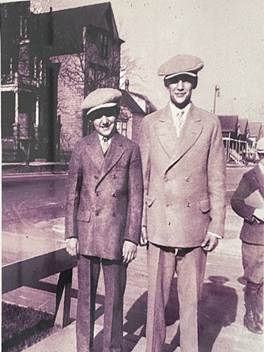
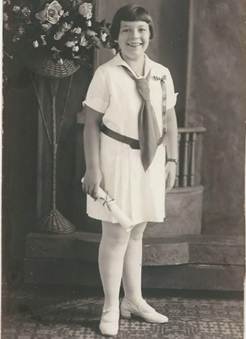
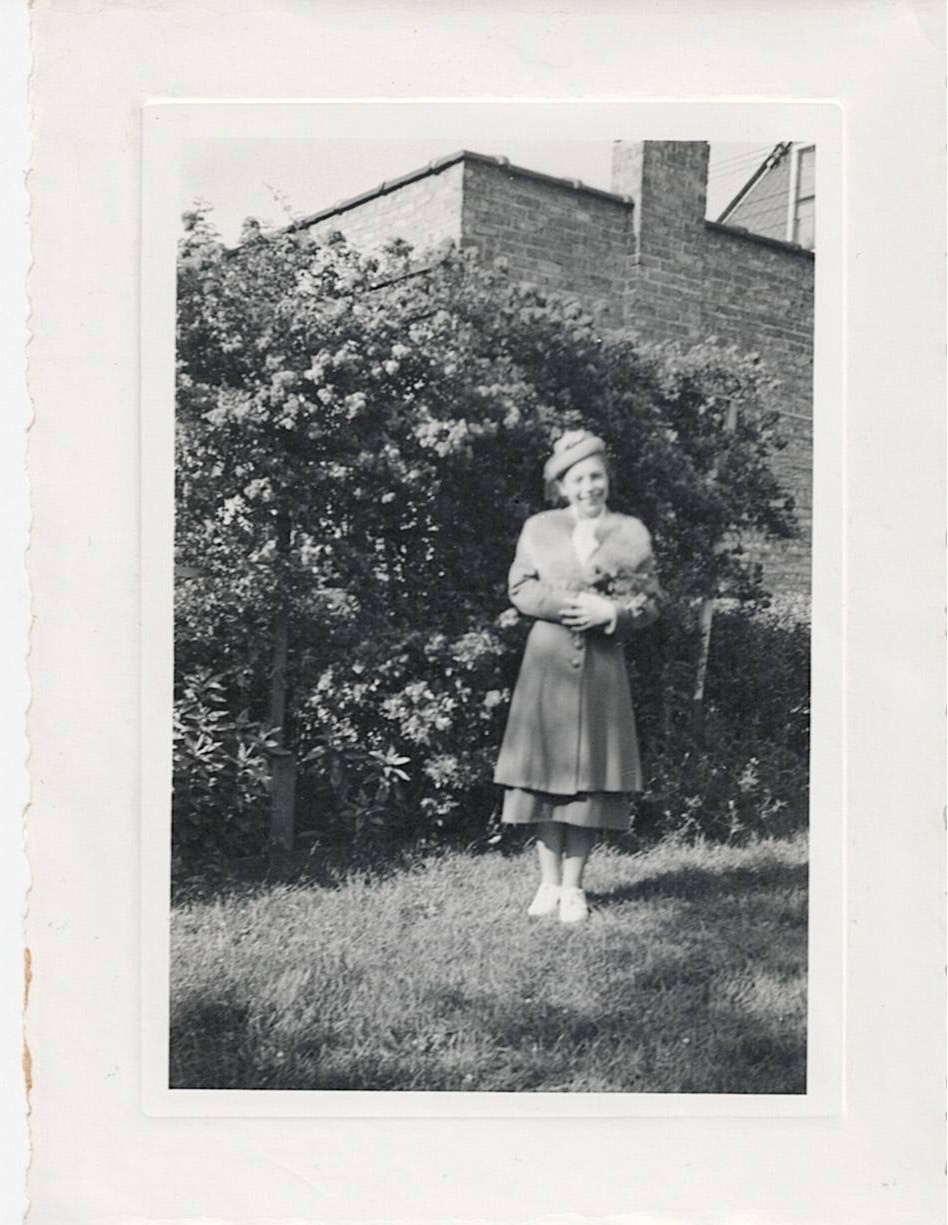
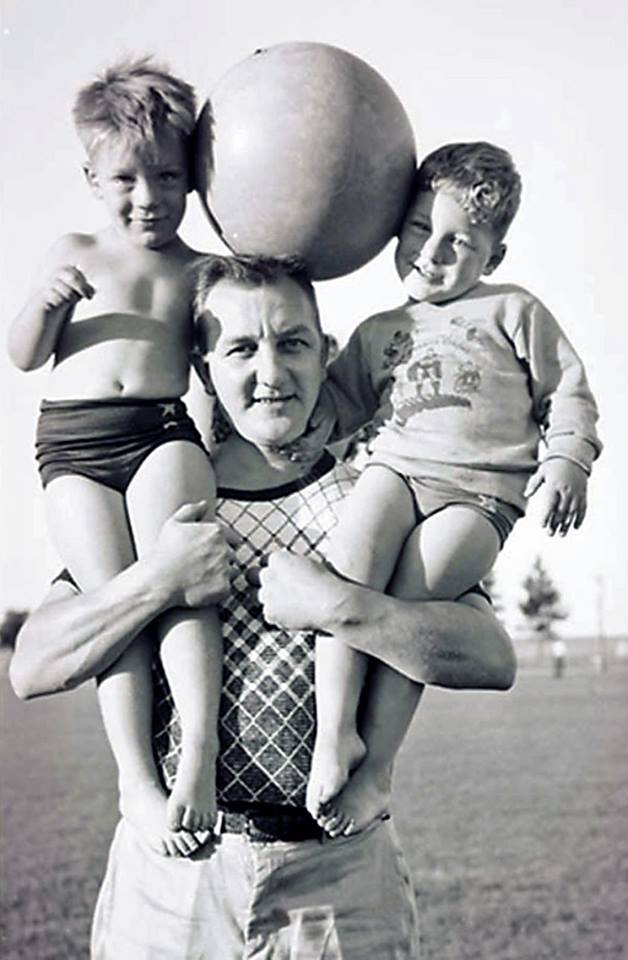
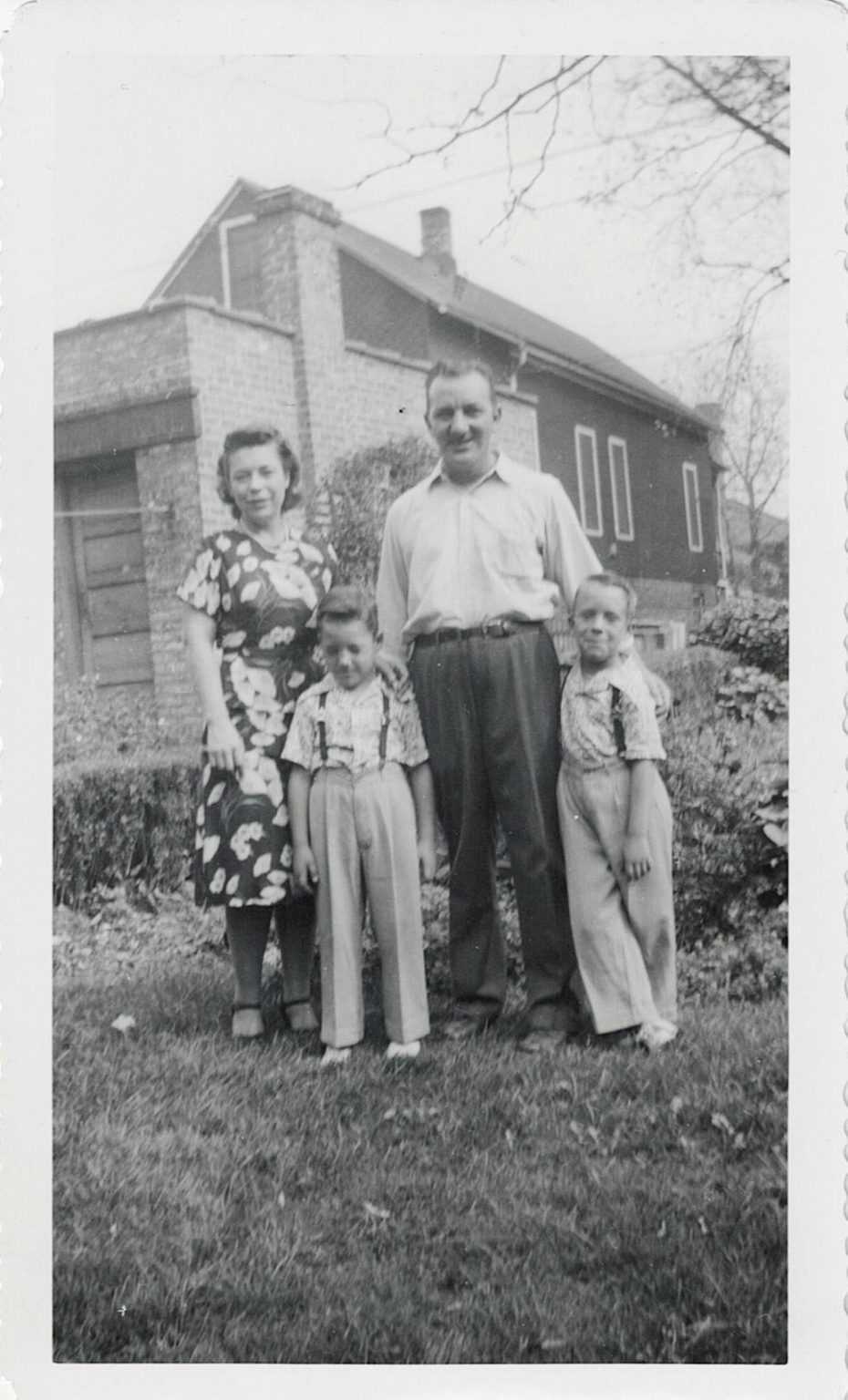
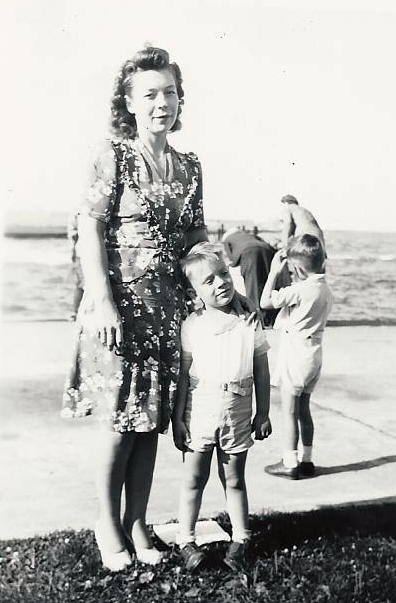
Here are photos of George (with older brother Harold) and Marian when they were children:
As noted elsewhere on this blog, Frank and Anna took their young family back to the “old country”, then part of Yugoslavia, in 1926 to visit their parents and other relatives. The timing was intentional. Their son John was 11 and if they waited any longer, they would have to pay full fare for his travel. Marian was eight years old and always told the story of their ocean crossing, hanging out of the open portals to see the sharks. One little girl on the ship was too small to look out over the portal, so they lifted her up, put her head out, and held her by her legs and feet. Even into her old age, Marian cringed at the thought. On that visit, John and Marian played with their second cousin, Anton Letang, who lived across the street from their Grandma Quint’s house. You can read about Mr. Letang elsewhere on this blog. In time, I will add a link.
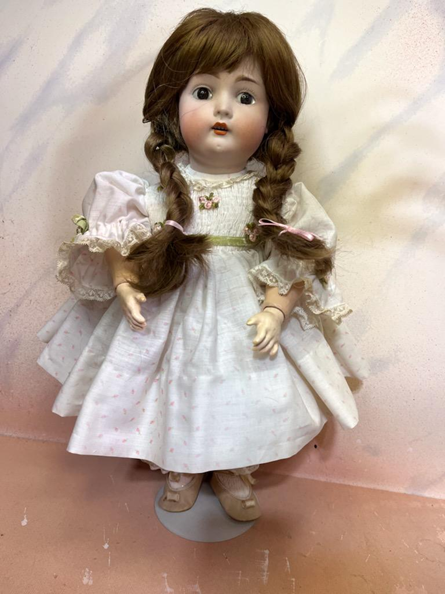
The Kahles family returned to Chicago after a four month stay. On way home, Marian begged her mother Anna to buy her a doll. It seems Anna did buy her a doll, but not the exact one she wanted. It turns out though, the doll she received is lovely. Here’s a photo of that doll which has recently been restored.
Marian’s Doll from Europe
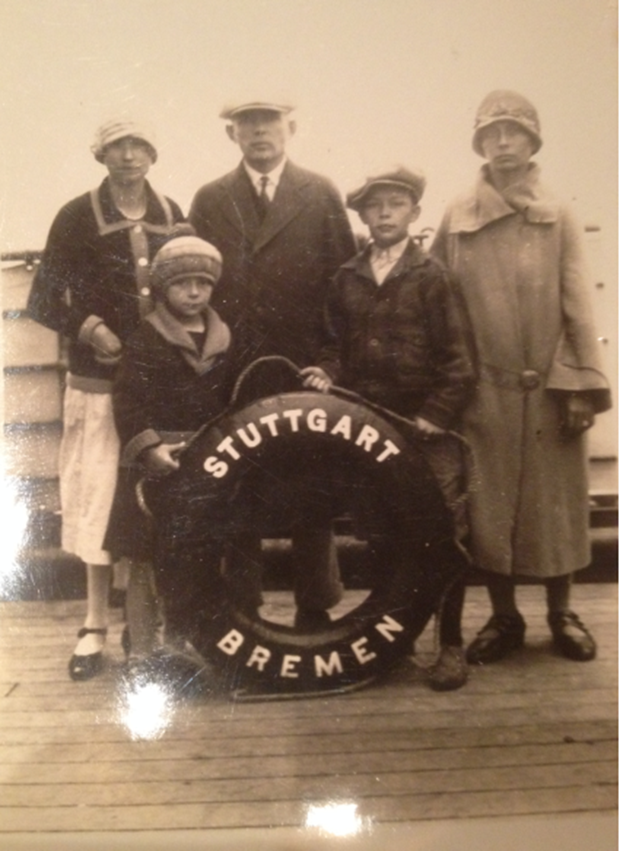
The young Kahles family boarded the SS Stuttgart in Bremen, Germany for the voyage home. On that journey, Frank and Anna met Elsa, a fellow traveler. Here’s a photo of Elsa with the Kahles family.
When reflecting on the events of 1926, Marian often said she returned to the United States speaking English with a German accent.
George meanwhile continued to be special. While the first five Lang children got jobs and started working immediately after graduating from grammar school, George went on to high school. Marian always told the story of the grammar school principal visiting the Lang house to tell George’s mother, Kreszentia, that George was smart and that she should let him go to high school. He did so and graduated from Lane Technical High School which is still there today. George worked during these years including a job at Riverview Park, a large amusement park in Chicago, which was one of our favorites destinations as kids. Riverview is gone now, but many great memories remain. With his technical background from high school, George soon got a job in the machining industry, working for Illinois Testing Laboratories (ITL) which began operation in 1919 in Chicago as a repair and service center for precision instrumentation. He didn’t know it then, but this job at ITL, which would later become Alnor Instrument Company, was the steppingstone that defined the rest of his life.
Marian, of course, graduated early from grammar school and went on to Lake View High School. A smart, young girl with good study habits, she graduated in June 1934 at age 16. From there, she went to Wright Junior Collage for two years and, among other knowledge and skills, became an excellent typist. She got a job with a company called Chicago Printed String Company which made ribbons and other tying materials for decorative and industrial use.
CHAPTER THREE: Love and Marriage
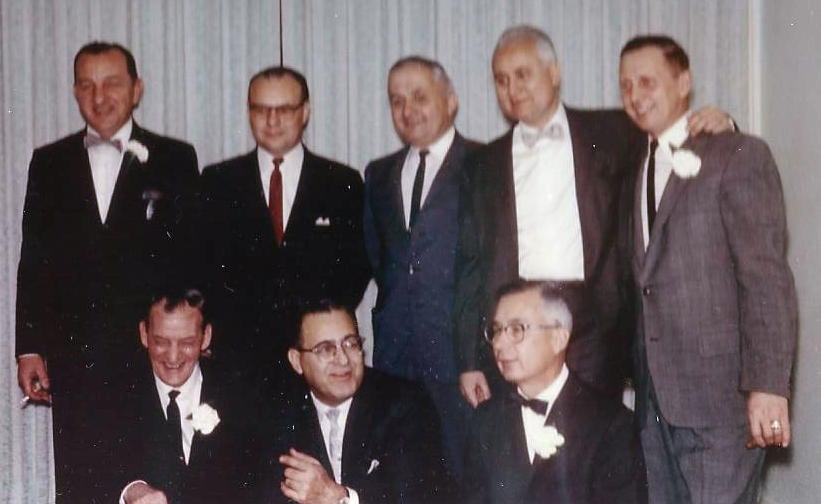
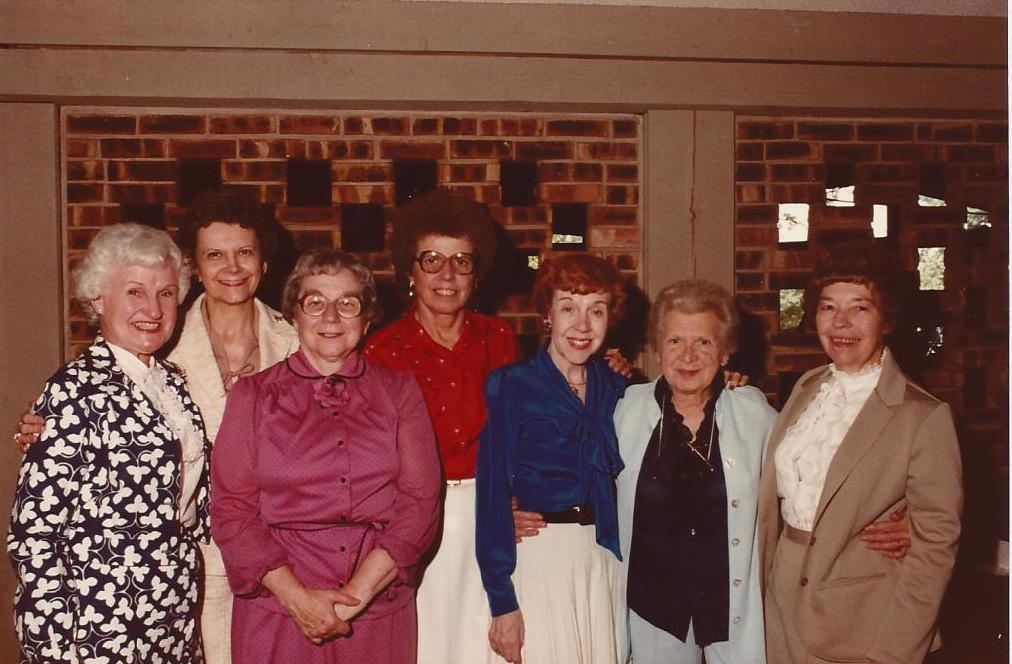
Piecing together multiple backgrounds, we can be reasonably sure of how George and Marian first met. Going to the same grammar school and living within the vibrant German community in the Lakeview area on the north side of the Chicago, they’re meeting was inevitable. George and Marian’s brother John were close in age and went to the same high school, Lane Tech. We know that each of them formed life-long friendships in those early years, Marian with the other young women from Chicago Printed String and George with a group of guys that called itself The Silhouettes. Marian was very close to some of the Silhouettes: her brother John, John’s friend Fred Phillips, and her nearby neighbor Bill Gruetzmacher. Other members were George, his brother Harold, Hank Ritter, and Ed Rauch. You can view photos of the Chicago Printed String women and the Silhouettes in their later years on the George and Marian Lang Gallery on this history site.
So, to Marian, it seemed like George was “always around” like so many of the other kids and her brother’s friends in the neighborhood. At first, she didn’t think of him in romantic terms, he was just George. Then not long before they were dating, George started coming to her house to read the newspaper. Marian’s parents began to suspect it wasn’t just the newspaper in which he was interested. Marian had blossomed into quite a looker, was always fun to be with, and was smart and levelheaded. George had recently broken up with his rather serious girlfriend who made the mistake of bragging that she had shortchanged someone who had overpaid. George broke up with her immediately and wouldn’t take her back. So, his attention turned fully to Marian. When she accompanied someone’s cousin from out of town to an event, George showed up the night of the date and went with them! He didn’t want them to be alone together. They started dating soon after, and the rest is history.
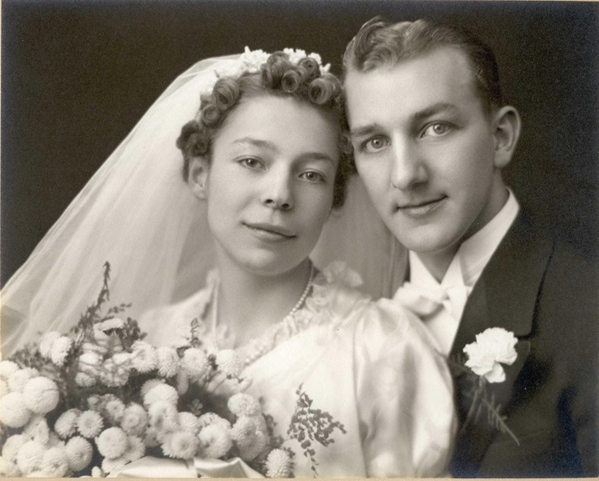
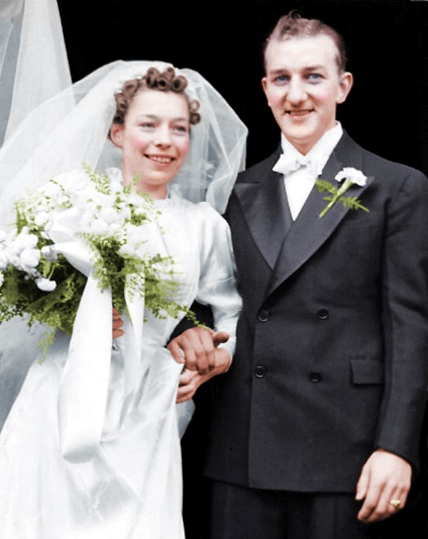
The wedding took place on Thanksgiving Day of 1939 at St. Alphonsus Roman Catholic Church in Chicago. This was after Marian converted to Catholicism and was baptized. She remained a devout Catholic for the rest of her life.
George and Marian Wedding Day
Their first apartment was on Belmont Avenue in Chicago across the street and not far from Marian’s parents’ place. This was a couple clearly in love and clearly having fun.
But life soon turned much more serious in the wake of the Japanese attack at Pearl Harber on December 7, 1941. It wasn’t long until George received his draft notice. Luckily, his company had government contracts including making gauges for the U.S. Navy. A representative from the company went to his draft board and told them they couldn’t carry out those contracts without people like George. Lucky for the young couple of course and also lucky for George E. Lang Jr. and Richard F. Lang (that would be me) who were born in 1942 and 1943 respectively.
During those early war years, George became acquainted with a wonderful and talented coworker named George Carson. At the time, Illinois Testing Laboratories (ITL) was outsourcing its supply of specifically designed, machine-made piece parts, parts made on automatic screw machines. The bosses decided to bring that process in house and bought several screw machines. No one knew how to set them up to make piece parts, so they assigned George Carson, a great machinist, to learn, teach and make it work. And he did.
In 1943, George and Marian bought the house at 2712 N. Oak Park Ave., further west in the city. When the two Georges saw the opportunity to use their newfound knowledge to make some money on the side, they bought some machinery and installed most of it in that house. As little kids, George Jr. and Richard lived with two automatic screw machines in the basement, singing them to sleep every night. They also lived with a drill press in the kitchen. Newly married Helen Carson lived with a bench lathe in her bedroom. Their venture was a success as they continued making piece parts for customers at night and on the weekends.
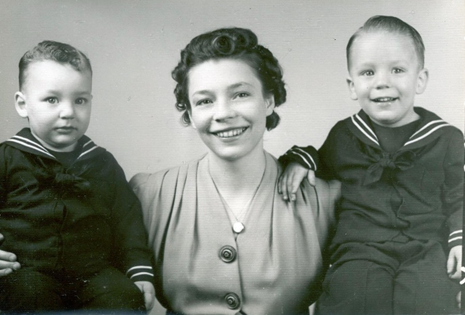
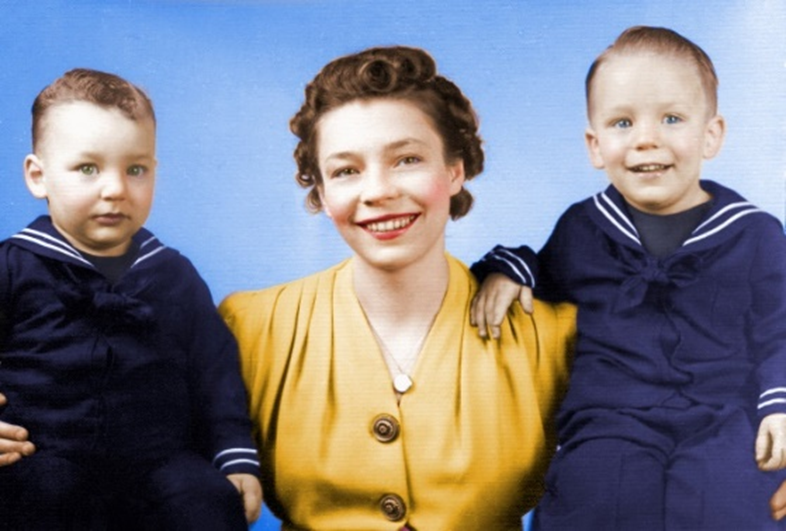
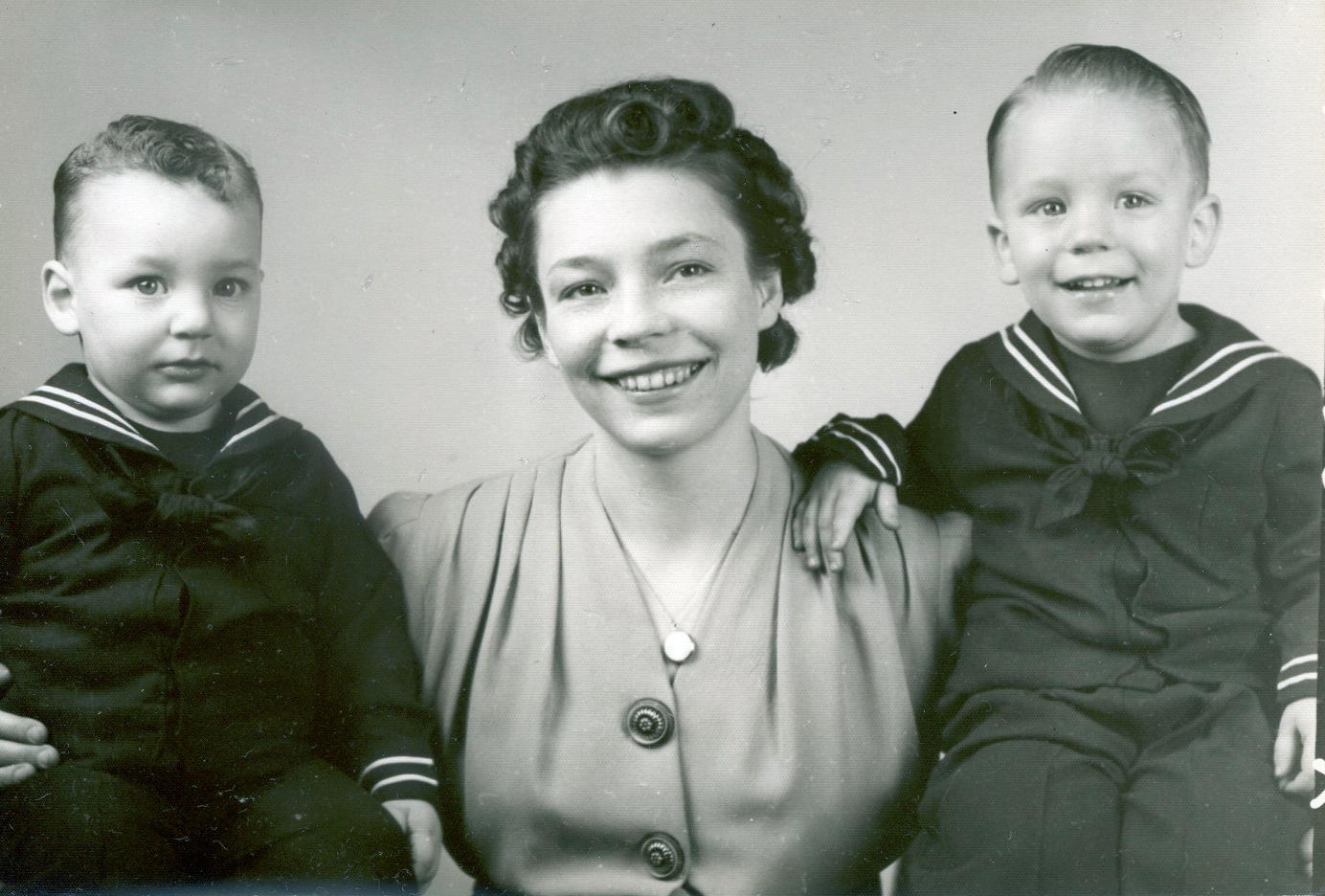
By the spring of 1945, the war on both fronts had turned in the allies’ favor. There was, however, another scary moment for George and Marian. George’s exemption had run out and he received another draft notice with a date to report for his physical. Marian wanted her husband to have a nice photo of her and the two boys, so her father, Frank Kahles, took the three of them to professional photographer. Fortunately, George never had to leave home.
This time, a rep from ITL was in Washington, DC. When he heard about the draft notice, he called George and told him he must NOT report for that physical, a prospect that had the couple frightened that he would be arrested. The rep, it turns out, was in the know. The war ended two days later.
Marian with Sailors
The two Georges actually formed a company in 1944 and called it Georges’ Screw Products, later renamed Georges’ Screw Machine Products. After the war, they found it increasingly difficult to do both their day and night jobs, so, they broke away from ITL and rented a small shop in the city. When it proved too small and they could afford it, they bought the long-time home of the company in Franklin Park, Illinois. And, as it turned out, their relationship with ITL really didn’t go south. As ITL became ALNOR after the passing of the original owner, the company again outsourced the production of piece parts, this time to Georges’.
George and Helen Carson (years later)
George and Marian continued through the years as they started, deeply in love and inseparable. As George worked hard to make the business a success, he transitioned into a polished and outgoing businessman. This was a perfect fit for George Carson who was always more comfortable running the operations of the shop. With Marian contributing by keeping the books, the business now had sales, finance, and production. At home, George and Marian became well known in St. Williams Catholic Parish with Marian serving for a time as the President of the Catholic Women’s Club.
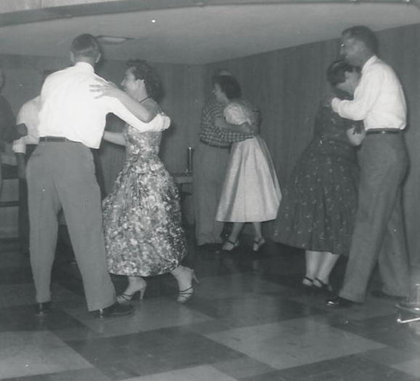
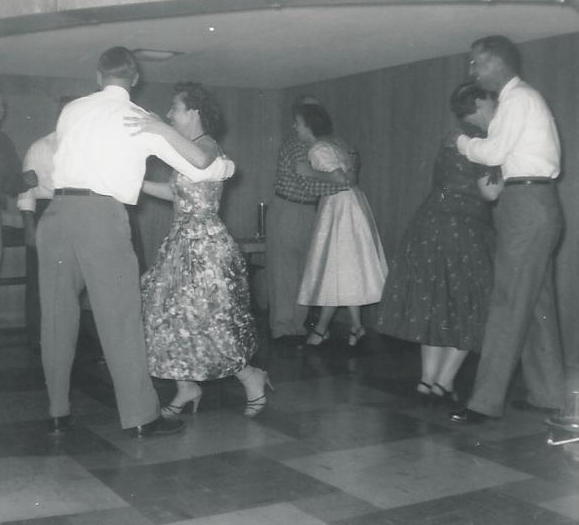
Along with their many friends, the couple enjoyed square dancing, and for a while, square dance parties were held monthly, rotating between houses.
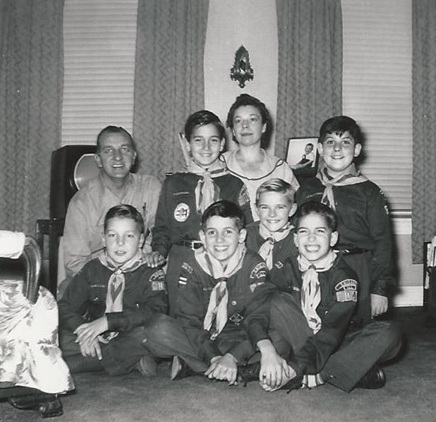
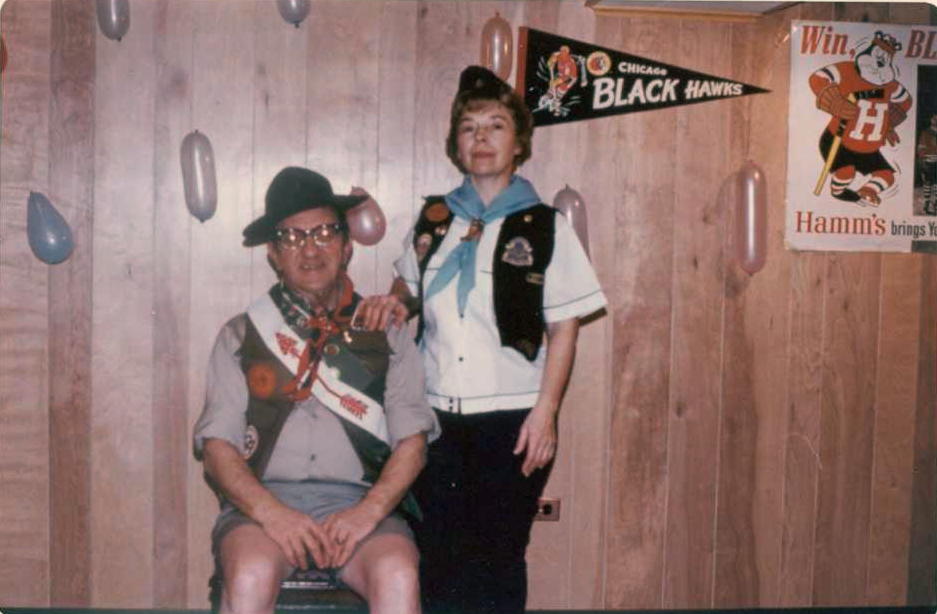
With two young boys, George and Marian enjoyed camping as a family and supported the parish scouting programs. Marian was the quintessential Den Mother and George assisted the scout master on nearly every outing.
Blessed as they were, a great new blessing came their way (and our way) in June of 1955 as Marian gave birth to their third son, Gerald E. Lang. By 1963, now with two college students and an eight-year-old, George decided that a move to the suburbs was in order. So off the family went to a new house in a new subdivision in Niles, Illinois, just a few blocks from Our Lady of Ransom Catholic Church.
In the years that followed, Georges’ Screw Machine Products became well-established and continued to succeed. George became well known in the manufacturing community and rose to become the President of the Northwest Suburban Manufacturers Association. He and Marian enjoy boating with new friends, and they continued camping, now in an RV. With more time available, George also enjoyed fishing, especially with son Jerry.
Son George Jr. (1942-2007) graduated from Loyola University in Chicago and went on to earn a PhD in Mathematics. He became the head of the Math Dept. at Fairfield University in Connecticut. He married Mary Beth Schnare and together they had two children, John Kenyon and Susan.
Son Richard (1943- ) graduated from Loyola University in Chicago with a degree in mathematics. He subsequently earned a master’s degree in business management and served 26 years in the US Air Force, retiring as a Colonel. He married Leslie Ann Dahlquist in 1966 and together they had two children, Douglas and Janice.
Son Gerald (1955- ) graduated from Western Illinois University, then worked at Georges’ until it was sold in later years. He married and divorced Marianne Cuddington (now deceased). They had three children, Sean, Drew, and Gina.
CHAPTER FOUR – LATER YEARS
George Passes Away
The opening page of this website provides the details of George and Marian’s visit to Wiesbaden Germany in May 1982. Several months later, I received a very disturbing call from my dad, George Lang. He said that doctors had found a spot on his lung. It turned out to be lung cancer, surely a result of his having smoked cigarettes since he was 11 years old. He was then 67. Despite radiation and chemotherapy, the disease progressed over the next year and a half, and he died on December 8, 1983.
Saying this was a tough year for Marian would be a total understatement. Not only were she and George inseparable since the late 1930s, but Marian lost her mother, Anna Kahles, earlier that year.
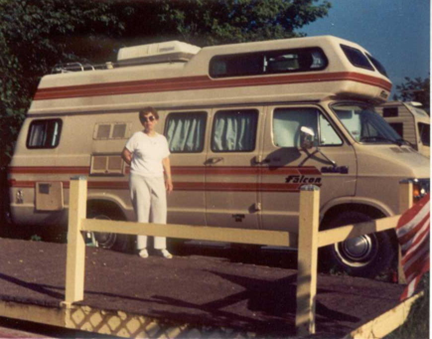
Just before he died, George told Marian to trade in the large RV they had been traveling in and buy something smaller that she could drive comfortably. This she did as you can see in the photo below.
And RV camp she did, many times. The outings with old friends and her camping group were normally within 150 miles of Niles, Illinois where she continued to live for the rest of her life. Immediately after George died, she went to their safe deposit box and found an envelope with five One Hundred Dollar bills that said, “For Outside Expenses”. She never knew what he had in mind, but every so often, she’d pull it out to pay for something, having decided it was an “outside expense”.
Marian’s Last Few Months and Death
As her eighties turned to her nineties, Marian still enjoyed visiting with friends and family and playing PoKeNo, but walking became more and more difficult as she lost strength in her lower legs. Understanding her strong desire to stay in her own house rather than moving to a care facility, the family found a wonderful woman named Darlene to live with her.
Marian turned 101 on December 6, 2018. We had a party, of course, something we’d been doing since she was 95. The event at Judy and Jerry’s house was well attended, with Jake’s poem a major hit. Just before Christmas of that year however, Darlene found mom in the family room around 0300, unable to move much or talk. A call to 911 got mom to the hospital, where doctors found she had suffered a stroke. With our authorization, they operated and mechanically dislodged the stroke-causing blood clot. Miraculously, mom was home and eating and talking by dinner time. As a result of the stroke though, she became even less mobile and lived, with Darlene’s help, in her family room.
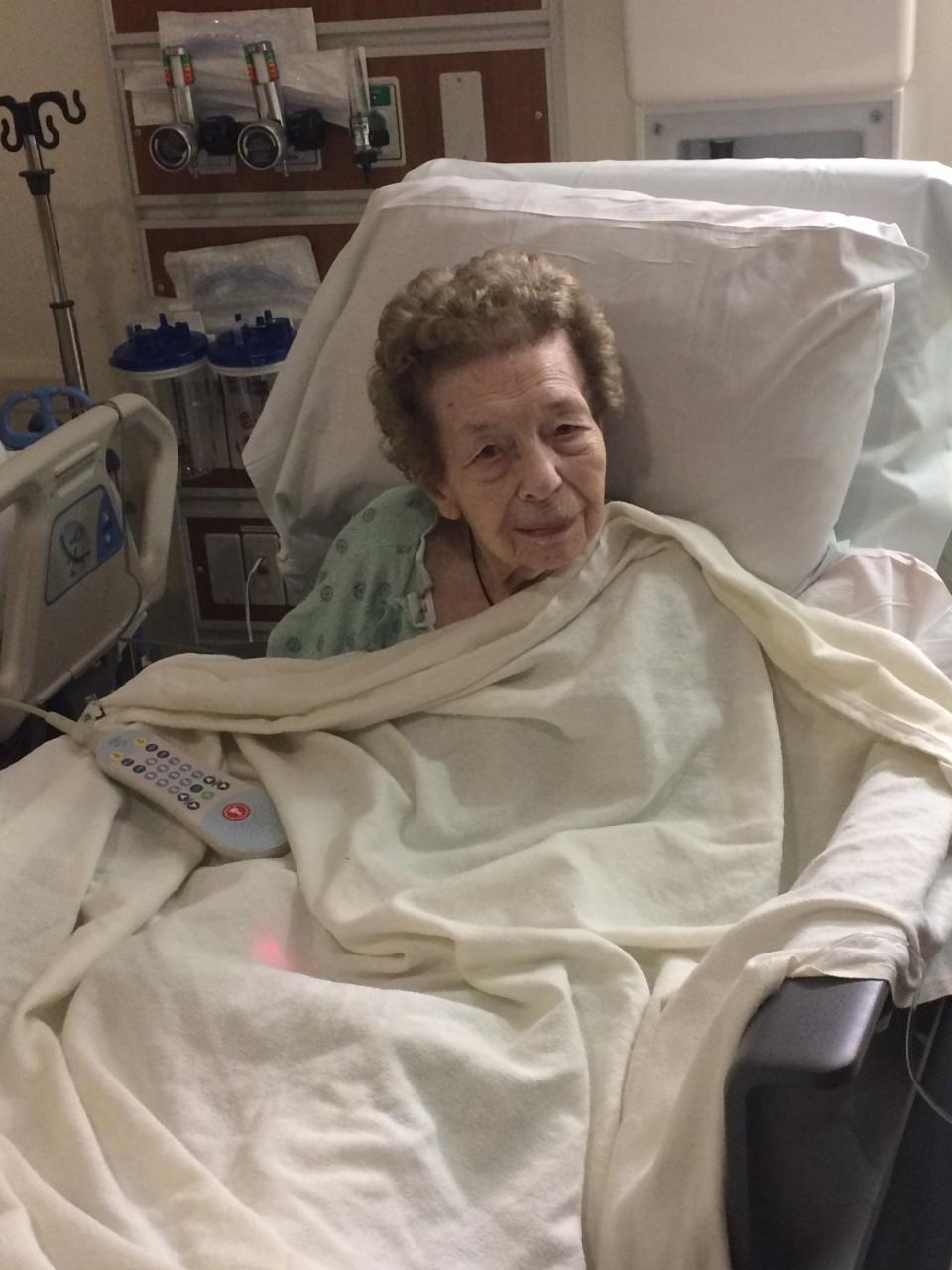
Marian suffered a massive stroke on February 20, 2019. This time, there was nothing the doctors could do for her. Acting on the recommendation of a palliative nurse, she was brought home and put in a hospital bed. With visits from various family members and regular visits from the hospice staff, mom lived until 2:10 pm on February 28th. In the presence of myself, Darlene, and the hospice nurse, mom opened her eyes very wide for about 10 seconds, then died.
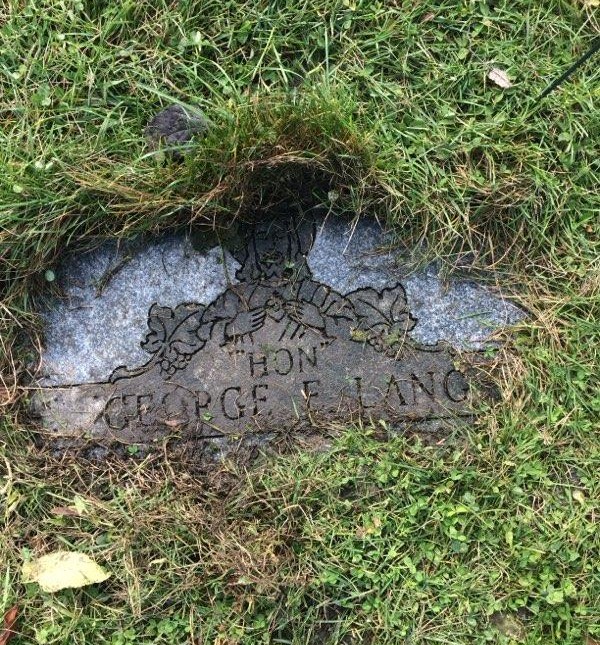
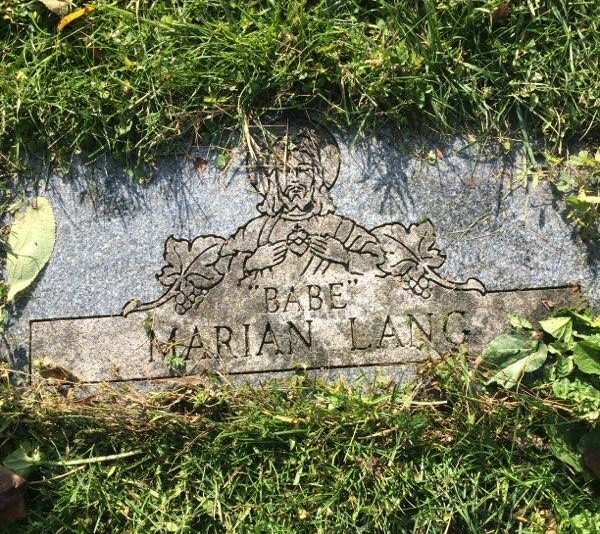
We had a one-night wake at Skaja Terrace Funeral Home in Niles, Illinois on March 3rd and a funeral mass the next day at Our Lady of Ransom Catholic Church. She is buried next to dad at All Saints Cemetery in Des Plaines, Illinois. The headstones? “HON” and “BABE” as they always called each other. No birth or death years are engraved on those stones – guess they’re both timeless.
Hon
Babe
Notes and Bonuses
1. See the post entitled “Franz Kahles Comes to America”.
2. See the post entitled “The John Breuss Story”.
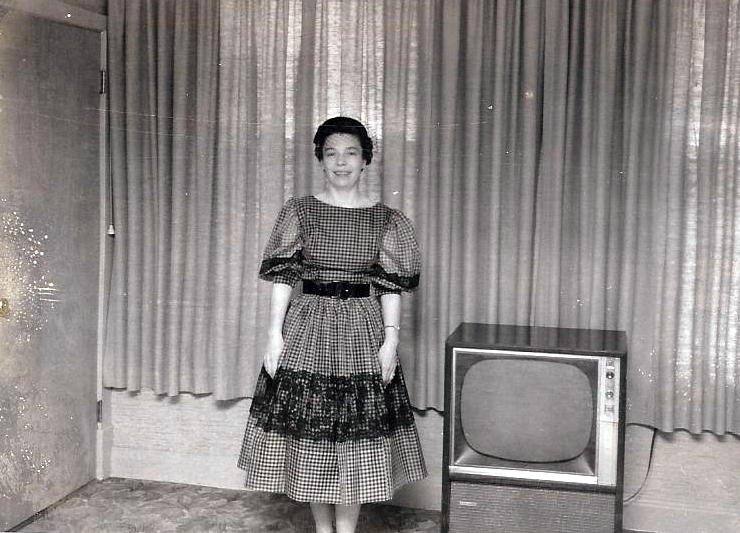
Great Granddaughter Annalise had some fun “colorizing” two old photos, guessing what it might have looked like at the time.
I think she nailed this one
Marian with Sailors
Who knows if that dress was yellow, but it sure looks great
In one of the chapters of Marian Lang’s Family Chronicles, my mother writes about her mother, Anna Quint, coming to America through Ellis Island. Her future husband, Franz Kahles, also came through Ellis Island. Both came in “steerage”, not an easy ocean voyage during those days.
We have no first-hand accounts from either Franz (Frank) Kahles or Anna Quint concerning their journey across the ocean. Since both came through Ellis Island in New York, we know that both travelled in steerage class. Accounts of travel at the time indicate that “only steerage passengers were processed at Ellis Island. First and second-class passengers were quickly and courteously “inspected” onboard the ship before being transferred to New York.”
Documentation also indicates that for most, crossing the ocean in steerage was a nightmare, a nightmare of crowded, unsanitary conditions and a 10 percent mortality rate. As late as 1911, in a report to President William H. Taft, the United States Immigration Commission said:
“The open deck space reserved for steerage passengers is usually very limited, and situated in the worst part of the ship, subject to the most violent motion, to the dirt from the stacks and the odors from the hold and galleys… the only provisions for eating are frequently shelves or benches along the sides or in the passages of sleeping compartments. Dining rooms are rare and, if found, are often shared with berths installed along the walls. Toilets and washrooms are completely inadequate; saltwater only is available.
“The ventilation is almost always inadequate, and the air soon becomes foul. The unattended vomit of the seasick, the odors of not too clean bodies, the reek of food and the awful stench of the nearby toilet rooms make the atmosphere of the steerage such that it is a marvel that human flesh can endure it… Most immigrants lie in their berths for most of the voyage, in a stupor caused by the foul air. The food often repels them… It is almost impossible to keep personally clean. All of these conditions are naturally aggravated by the crowding.”
Our ancestors survived the harsh conditions and, if their experience was like many, they heard plenty of rumors about life in America, stories of rejections at Ellis Island, and went through rehearsals for answering immigration inspectors’ questions.
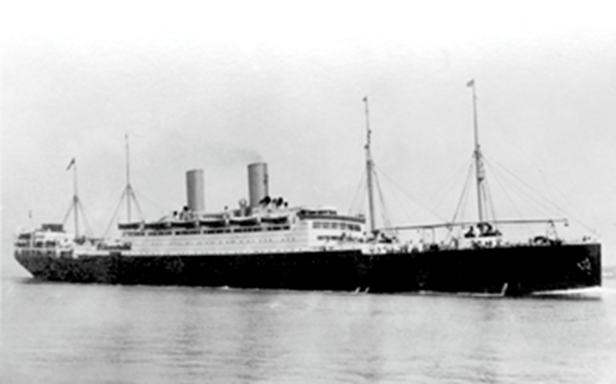
SS Cincinnati
Grandpa Kahles arrived at Ellis Island aboard the SS Cincinnati, pictured above, on June 1st, 1911. He was 24 years old and, while the ship had sailed from Hamburg, he had spent the past six years as a barber in London. The voyage to New York and subsequent journey to Chicago turned out to be his final fling as true wanderlust. Growing up in Sellesch, now Nakovo, a small, rural town in the Austrian-Hungarian Empire (that region is now part of Serbia), he was sent off to Vienna at age 12 to learn to be a barber. His cousin Frank Schwatje had done that as well, and it was a number of years before the young boys would learn to cut hair. They started out running errands, cleaning floors and cleaning toilets. But both became barbers eventually and started to wander. Their travels took them to Switzerland, Paris, and then Belgium. In Switzerland, Grandpa liked to go tobogganing on days off but stopped that practice after realizing that, if he injured his hands, he would have no way of making a living.
Mom believes it was in Belgium that the wandering cousins decided their next adventure with a coin toss. One side of the coin and both would go to China (we have wondered if they knew how the Chinese like their hair to be cut). Well, it wasn’t China. Cousin Frank went to America and settled in Chicago. Grandpa went to London, cut hair, and learned English. In fact, he learned English so well that he spoke it without a German accent. When he was about to come to America, he met someone in Trafalgar Square in London who told him, “Oh, if you are going to America, you should not pronounce your name “Kahles” (with a short “a”-Kaahles), but “Kahles” (with a long “a”- Kayless). So ever after, he did. And that is the origin of our Americanized vs. German pronunciation of Kahles as we knew it in our and our parents’ generation. With his cousin in Chicago, it was inevitable that Grandpa would settle there where he would meet and marry Anna Quint, my Grandma, who came from Bocar, a small village less than 30 km from Nakovo.
Frank Schwatje established a barber shop on Addison Ave. in Chicago, but Grandpa never worked for him. Frank and his wife Lissie (known to mom as Lissie Tante) had three kids, Rosie, Elizabeth, and Mary Jane. Uncle John stood up for the first two at their weddings. Lissie was described as a compulsive housekeeper and shopper, confirmed after her death when they found six trunks of linens in the basement, all unused.
My Brother, John, was buried yesterday, and a part of my sister-heart with him. Is it strange to say that part daughter-heart is with my Mom and Dad and certainly; my lover-wife heart will always be with George? A heart must have many facets because I still have much love to share with my family, friends, and you, whoever might care to read this.
As part of the funeral Mass, four speakers eulogized John, each with their own memories of him as an adult. My memories and thoughts went back to our childhood memories of John, the early years with you, if you will. I would share a few.
Mom told me many times over that John was never ever jealous of me when I was born. I was his little sister and he looked out for me, always. I like to think that it was never in John’s nature to be jealous or envious of anyone.
My very first personal memory took place on Ward Street in Chicago when I was three years old. My Mom was talking in German, almost in a whisper. Translated, “Johnny, Johnny you could have been killed, you have to be careful”. It seems that he had almost been run over by a car. John was six years old and allowed to a play outside. I do not have any of the details, only the memory of that conversation.
John, if anything was always enthusiastic and excited about everything. He attended Prescott School for the first grade and when the family moved to Belmont Avenue, he was enrolled in the Schneider School. The spring after we moved a baseball game was scheduled between Prescott and Schneider. John burst into the house after the game and was so excited. “Mom, we won” he shouted. Mom was happy because it meant that he was adjusting to the new school. Somehow, she must have mentioned Schneider School. “No, Mom, it was Prescott, when I saw Schneider was losing, I went over to the other side”. True story which was told and retold by Mom and always with a hearty laugh.
John coaxed me to play marbles with him on the living room rug. He would lay a string in a circle to be the ‘pot’. And he would show me how to hold the marbles and how to shoot. No matter how hard I tried he always won. When he played with the boys in the dirt, and dirt it was, I could be a spectator. However, I always rooted for him and was happy when he won some good ‘aggies’.
The kids in our neighborhood were great for flying kites in the springtime. Hamlin Park ball field was the favorite spot. I was very young but just old enough to cross Belmont Avenue. Mom would pack a sandwich and cookies and I would take them in my doll buggy to bring lunch to my brother so that he wouldn’t have to wind in the string and come home. I loved that. Then he would show me how he sent messages on slips of paper up the string to the kite.
And we would wrestle for fun on the living room floor. Of course, he would always win but eventually I learned a trick. If I could manage to kneel on his arms and make him laugh, I had it made.
And then there was fudge. I hated fudge. But John wanted to make fudge and had a recipe that called for putting a small amount of the cooked ingredients into cold water for testing. Something always went wrong with the testing because the candy would have to be recooked in order to harden. The result was crumbly and sugary but I was coaxed to eat it so he could make more another time. The first time I made my recipe for ·•Old Fashioned Fudge, I sent him a box and marked it ‘Cooked only once, honest’!
Miss Doerr was our Fourth-grade teacher. She was a tall, heavy woman and most kids were really scared stiff of her. One day John came home from her grade with all ‘E’s in his subjects and a big red ‘F’ in deportment. Disaster! A bad mark in deportment was not tolerated in the Kahles household. When Mom talked to Miss Doerr the teacher told her that John had not misbehaved but that she couldn’t talk to him. He always cried. So, Mom took John to our family doctor for a checkup. Dr. Becker prescribed a rest period after school. It was to be done in just this way. He was to sit in the big, overstuffed armchair with his arms resting on the sides for fifteen minutes before going out to play. John never cried in Miss Doerr’s room again and got good grades in deportment. I like to think that the rest period might have helped, or John began to think that crying was not worth fifteen minutes of play time.
When John was in the seventh grade he cried again. His then girlfriend, Ruth, told him she liked another boy. Elsie Schilling, another classmate, consoled him with the old saying, “There are other fish in the sea”. And how happy how grateful we all are that John found a magic sea in Cincinnati and there found his beautiful, true love, Bea. She was and is the love of his life.
And there are many stories of John’s early years. The school yard fights all the way up to the fun of waiting up for each other to talk about our girl and boy parties.
But it is nearing midnight and now my thoughts are of Pearl Buck, the author of ‘The Good Earth’. After her husband of many years died, she could find no rest, no peace, no consolation. Finally, after a few years she returned to China where she had spent many years. There she climbed up a mountain, alone, and when she reached a certain point she sat down and put her back against a warm rock. She wrote that she sat there for a long, long time and finally found peace. I like to think that we must all find our own warm rock, whatever that may be, to find peace within ourselves.
There is a rock waiting for me to heal the hurt of John’s death. I don’t know where or what it is. I only know for certain that it is there, and I will find it.
It has been a while since I have written about Mom, her relatives, and her early family life. I would like to take a little time to digress and “talk” to you, if you will.
It is Mom’s Birthday today, a gray and snowy day here in the Midwest. I wondered what it was like weather-wise in Bocar the day that Mom was born and what care and comfort was afforded Grandma Quint when the baby was born. Just thoughts of mine on this day. Catholics have a tradition of praying for the souls of the dead. I prayed for Mom as I do every day, but this day I offered my prayers at Mass. A candle was lighted at the altar for the peace of her soul. I think she would have liked that, but if not, certainly the ritual was a comfort to me. I miss her so much.
Peggy and John Lewis along with Susan Kahles visited with me yesterday. No Gram-goodies for them but I did make Susan’s favorite cherry coffee cake which they enjoyed with tea and coffee. Quite a bit of the conversation centered around their experiences with Mom. We all agreed that it is not realistic to beatify the dead. Mom, great though she was, had her faults and failings. I’m sure that at a future time they will find their way into the record.
Changes are taking place in the Kahles and Lang families. Peggy is organizing a Kahles family newsletter which will keep us up to date. It is possible that Dick might incorporate some of them into the Family
Chronicles. As for the Lang’s, Dick and Leslie’s son, Doulas is now a sophomore in college. Jan1ce will graduate from high school in June Kenyon, George, and Mary-Beth’s son, is in Prep School and Susan Quint will soon be twelve years old. The exciting news of 1988 was the arrival of Gina Elizabeth, a Korean born baby, who is being adopted by Mari and Jerry. She arrived at O’Hare Airport on September 19th, just five months after her birth on April 19th. She is an adorable sister for Sean, eleven years old and Drew who is seven. What a precious gift for the whole Lang family.
When I began writing about Mom a little over a year ago, I was preparing to “jelly” the Vanilla Grentzla. It is that time aga1n. I just finished baking the cookies and now it is time to put the cookie halves together with the jelly. They are going to be sent to Mary Beth in her Birthday box. Verbalizing love is absolutely essential and wonderful but sometimes I think my kids enjoy having love expressed in the form of cookies ‘n stuff.
Okay, Dick, you told me that I am always moralizing. Sorry, can’t help it, it’s just me.
Love,
Anna Quint Comes to America
January 27, 1990
Dear Dick
It has been almost a year since I have written for the Family Chronicles.
I must tell you about ·Theresa White. Theresa is a widow friend of mine, a teacher of special education in the Chicago school system. After her husband died, she was caught in a position of almost uncontrollable grief along with family concerns. After a time and with the encouragement of her children she decided to continue her graduate studies. She was awarded her PhD in Education last May. We were conversing one time when I told her about my effort to write my Mother’s memoirs. I met her the other day and she asked me how I was coming along with the writing. I told her that it had been a while and that Mom was on Ellis Island. She urged me to get on with it and I said I would.
A psychiatrist would not find it too difficult to diagnose the reason for the procrastination. It has not been that I have been too busy. My everyday life is busy and during this last year, I have again enjoyed the camping season and my trip to Europe. I had wanted for a long time to experience Michelangelo’s Sistine Chapel, to spend at least a little time in the Louvre, and to stand in the Square in Florence.
All that, yes. But this evening after some soul searching and a few tears I realized why Mom was still on Ellis Island. With her arrival in America, it would become a time when her life and mine would intertwine. Our love for each other was very strong and losing her has been painful. The memories might be difficult to record.
Well, painful or not, I can’t leave Mom on Ellis Island for the second time, especially since the first was not too happy.
Sixteen-year-old Anna Quint travelled alone, steerage class, for almost three weeks. Seas were stormy and she really didn’t know which was worse, the continual seasickness or the homesickness.
As an immigrant she came with her clothes tagged with her destination and one rattan suitcase holding her only possessions. She cried most of the way.
November 2nd, 1909 is recorded as her arrival date on Ellis Island. An immigration officer trying to transfer her suitcase to the train bound for Philadelphia was met head on by a very determined Anna not to be separated from her only possession. A tug of war took place with the case between Anna and the officer. Finally, exasperated he pushed the case to her and said, “Get the hell out of here”. She understood. Welcome to America, Anna.
Love,
Ann Quint – Philadelphia and Chicago
February 20, 1992
Dear Family
Dick Lang, Susan Kahles, my friend Theresa White have all been urging me to continue with “Mom’s Story”. A few days ago, Tribune columnist Bob Greene wrote an article urging all parents to record family stories but also interesting bits and pieces of their own lives. Perhaps I will do so someday.
So here it is February 20th, 1992, Mom’s 99th Birthday. I went to Mass this morning to offer it up for her joy and peace and to light a candle. I whispered a “Happy Birthday from all of you and a tear from me.
Well, on with it. The last effort left Anna Quint on Ellis Island.
Anna was put on the train, her destination Philadelphia noted on the tag pinned to her clothing. She was met at the train station by her Sister, Maria (Marta Tante) and the family with whom she was going to live as a domestic. Their name was Gleich. Mrs. Gleich was a warm-hearted Jewish lady who took Mom into a loving family home.
Mrs. Gleich took this tiny homesick sixteen-year-old girl, exhausted after three weeks of ocean travel in steerage and promptly put her to bed. She covered her with a warmed blanket. Warmed is important because it must have seemed like heaven to Anna. Mom never talked about The Gleichs without mentioning the warmed blanket. Years and years have passed but I still like to imagine Mom cuddled up in that warmed blanket.
Originally Anna was hired to talk German to the Gleich children and to do some 1ight housekeeping chores. However, it didn’t take the family long to discover that Anna was an excellent cook, and to marvel at the wonderful strudels, kuchens, tortes, breads, and pastries that she made for them.
She was happy with the Gleichs. She saved every penny she earned until she had enough to repay the money paid for her passage to this country. After the debt was paid the first thing, she purchased for herself was a blouse. On her free day, Thursday, she would meet with her cousins Christine, Elizabeth, and her sister.
I’m not sure just how long Mom lived with the Gleichs but one day there came a time of decision. Her sister returned to Europe to be married to John P. Lux. John’s sister, Emmie Boesa lived in Chicago so after the marriage the newlyweds returned to the United States and settled in Chicago. Mom wanted to follow her sister to Chicago.
When she arrived in Chicago she went to work for a family by the name of Britton. The Brittons lived on the Gold Coast and Mom was hired to be a cook. The family consisted of the Mother, Father and two teen age sons. The family budget was very rigid when it came to the purchase of food and the Britton boys were always hungry. On Sunday, one roasted chicken was carefully carved, one piece placed on each plate with no seconds. The leftovers were served the next day soup made from the bones.
However, it wasn’t as Spartan as it seems. Mrs. Britton was a sister of one of the Wielands of the Wieland Dairy Company of Chicago. The Wielands supplied the Brittons generously with mi1k, cream, cheese.and best of all, whipping cream. Mom loved whipped cream and would eat the dessert before the meal was ready to be served.
On Thursdays, maid’s day off, she would visit with her sister and her husband. John Lux was a janitor for an apartment building 1ocated on LaSalle Street and he and Marta Tante lived in the basement apartment.
I’m not sure how much time was spent in the flat on Southport Avenue because sometime between May 19, 1913 and September 1914, Dad had purchased a barber shop which was located at Montrose and Damen Avenues in Chicago. It was there that John Frank Kahles was born on September 11, 1914.
Kahles Family Moves to Renville, Minnesota
A sad time followed about the time that John was six or seven months old. Dad suffered a nervous breakdown which followed some minor surgery. Mom took care of John, cooked for the barber who was employed at the shop and visited Dad in the hospital. Following his stay in the hospital and keeping appointments with his doctors he was advised to leave his trade. He was told to go out into the country and work in the fresh air.
The barber shop was sold, and they moved to Renville, Minnesota where other friends and Landsleute had located. They rented a farmhouse. There was a large garden and room for chickens and a cow. Gram also raised a little pig. To earn money, they hired out to farmers in the area. The principal crop was sugar beets. The beets were picked by workers crawling on their hands and knees between the rows. Along about this time Mom became pregnant with me which she always said was what she really needed at the time. However, as her pregnancy progressed, she decided that it would be nice to have another boy who would be a companion to John. She could always picture, the two little boys dressed alike. No wonder then that she delighted in sewing matching suits and clothes for my boys, George Jr., and Dick Lang. But as fate would have it the baby turned out to be a girl, Marian. I was born on December 6, 1917, Renville, Minnesota. Mom said the temperature was 44 degrees below zero and the chickens had to be brought indoors so they wouldn’t freeze.
There has been some confusion about myname. The Doctor’s Certificate lists my name as “Maria Anna”. Mom said a neighbor visited her while she was still in bed after giving birth to me. She asked about my name and when told, “Ach, that’s too long for a baby, put the two names together and call her “Marian”. Fast forward to my application for a passport. Doctor’s Certificate not legal. Application sent to Minneapolis. The returned legal document lists my name as “baby”. But I was baptized in the Catholic Church in Renville. My certificate lists my name as “Marian”. So it is!
I will try to tell you a bit about Mom’s brothers and sisters. Grandma Quint bore ten full term children and a premature still born girl. They were:
Anton
Christian
Elizabeth
Johann
Lenchie (Magdalen)
Nicholas
Frantz
Maria (Marta Tante)
Margit
Anna (Mom)
Anna
Anton, the eldest Quint child died at the age of ten as a result of diphtheria. His death broke Grandpa Quint’s heart and Mom said he never reconciled himself to that loss. Christian and Elizabeth died in infancy. Johann and Lenchie were very much a part of Mom’s childhood as was Maria. John and I knew Maria as Marta Tante, who, by the way, was my Godmother. Then there was Margit, two years older than Mom, a whiner and spoiled child.
Grandma Quint and Her Pilgrimage
Nicholas and Frantz were retarded. This was a very serious burden on the family. Mom was not sure of the degree of retardation, but she understood that there never was any hope of the children reaching adulthood. Grandma Quint was a very devout woman and prayed to the Blessed Virgin to take them to heaven. If that should come about, she promised to join a pilgrimage to honor Our Lady on one of her special feast days. The boys died. By that time Maria had already been born. One day forerunners came to Bocar announcing the fact that folks from distant villages were coming through on a pilgrimage to honor the Blessed Virgin. Remember, no telephones, radios or TV news and no time for elaborate preparations. Grandma, true to her promise, hurriedly made arrangements for her family, gathered some food and clothing in a bundle and prepared to join the pilgrimage. It was a three day walk to the Cathedral. Pilgrims walked all day and at night were allowed to sleep in barns or townspeople would put them up for the night if they had room in their homes. But Grandma had another problem. Maria was still nursing, and it was very important for Grandma to “keep her milk”. In order to do that she nursed babies on the way. Although Grandma was able to leave her family with relatives, there were others who had to carry their infants along with them. When Grandma returned home, after all her effort, she found that Maria absolutely and in no way was going to nurse again. Mom said she was stubborn even then!
Anna’s Baby Sister – Anna
Grandma Quint stretched her leg out from under the down comforter to rock the wooden cradle next to her bed. The child being rocked was Mom and her very earliest memory was that of being lulled to sleep by her Mother pushing the cradle with her foot. She was still a small child at about two and a half years of age and probably still fit nicely into a cradle.
Also firmly engraved very early in her memory was the birth of her premature still born sister. The baby was named Anna. Mom could never understand just why her parents named her Anna, but that is what they did. An Uncle made a tiny wooden casket for the preemie and she was waked in the home. Big Sister Anna, not even three years old knelt in prayer in front of the casket. She felt very, very important and even when she grew old, she could still recall that feeling.
Most children unless their parents were wealthy did not own a “real” doll. Their dolls were made of bits and pieces of cloth or wood. The little preemie was tiny and beautiful, and Mom distinctly remembered asking if she couldn’t keep her for a doll. Grandma Quint cried and when Mom grew older, she could understand the reason for the tears.
Anna at the Ovada
I’m not sure that you have ever heard the word “Ovada”. I enjoyed hearing Mom talking about the Ovada and when I was little, I liked to say it out loud. Try it, it is a soft sounding word, as compared to the rather brittle sound of “kindergarten”.
The Ovada was a sort of pre-school since children were enrolled at the age of four. When they were six years of age, they began their six years of formal schooling.
It must have been a very pleasant time for Mom because she referred to the Ovada in a loving way. Of course, being a Quint, she was very bright.
Just kidding! No, when I think about it, I really am not because I have a little cup which she won as a prize for being the brightest in her class. She treasured this cup, and it has been broken and mended a number of times. Many years before she died, she gave it to me to treasure. And I do.
I would sometimes visit when Mom took her turn to entertain the Bunco Club. A number of the ladies in the club would tell me that they had gone to the Ovada with Mom. I just knew that they had never won a prize cup. Atta girl. Mom!
Anna’s Recitation Dress
Once a year around Christmastime all the school children were invited to the home of the Countess. It was a very special time because each child would receive a small sack of candies and nuts as a treat.
As part of the entertainment, Mom, now in about the first or second grade, was chosen from her class to give a recitation. She practiced diligently at home.
Mom’s school clothes consisted of her sister Margit’s hand-me-downs. They were clean but often patched up here and there. However, on the day of the party she was to wear a nicer dress. The arrangement was made for her to go back home to change. When the time came for her to do so and she hadn’t arrived, Grandma Quint panicked. She brought the nicer dress to school and not finding anyone there ran hurriedly to the home of the Countess. She entered the home just in time to see Mom, in her patched-up clothes, standing proudly on the stage in the ball room giving her recitation in a loud and confident voice. Grandma was really embarrassed. It must have caused an argument in the house because Grandpa Quint said that Mom could have a “new” dress for once. She was allowed to choose the material and remembered that it was as she put it, really’ cheesy, certainly not meant for long wear.
Typhoid Fever Strikes the Girls
One year typhoid fever was rampant throughout Bocar and neighboring villages. If I’m not mistaken it was a result of unusual flooding in the area.
Two of the victims of this terrible fever were Mom and her sister, Maria (Marta Tante). They were very ill, and both drifted in and out of consciousness for many days. Marta Tante was six years older than Mom and though Margit was only two years older it seems that she was not ill or perhaps had a milder case of the disease.
At one point it was not certain that the little girls would live. Katy, Mom’s Aunt, came to visit. In a hushed voice she talked to Grandma Quint and said, “If one of them has to die, it would be better for the little one to go because the older one can be more helpful”. Mom said she heard this and was so angry that she determined to get well. She blinked her eyes and her horrified Aunt said, “I think she heard me”. Indeed, she had and Mom always attributed her will to conquer illness to that specific time in her life.
The girls lost all of their hair as a result of the high fever. Grandma Quint crocheted little caps for them to wear when they were able to go back to school. Their hair grew back curly!
A Sprinkling Can that Never Arrived
We have all heard the story many times over about Mom’s most bitter disappointment. Of course, it was about the sprinkling can. When Susan and I talked about writing a few things about Mom’s life, she said, “And don’t forget about the watering can”. No, Susan, it was never a watering can, always a sprinkling can.
But for the sake of this little effort let us recall that Grandpa Quint was a rope maker. At various times of the year markets were held in neighboring villages. Tradesmen and farmers would gather from many miles away to sell their produce or their wares. And Grandma and Grandpa Quint would travel by horse and wagon to show and sell his ropes.
Before they left on one of their treks, they promised Mom that when they returned, they would bring her a sprinkling can. They were gone several days, and Mom waited almost nervously for their return. The time finally came but there was no sprinkling can for her. She was crushed. It was almost a tragic disappointment and I sometimes wonder if she ever quite forgave her parents.
You all know that story because Mom never forgot. After she retold it the final line was always this.
“I never promised my children anything I couldn’t keep, including a spanking”.
The Curious Case of the Prized Pear
Mom was not the only Quint to experience disappointment. For many years Grandpa Quint nurtured a certain kind of pear tree. The tree was healthy but just did not bear fruit. Lo and behold, one year the tree rewarded his efforts with just one beautiful, huge pear.
He picked it while it was still green and placed it high on the rim of the big white oven to ripen. When it became ripe, he promised to cut it into slices and share it with the family.
Guess you know the rest. Mom could not wait and every now and then she would steal a bite from the back of the pear. Eventually only one half of the fruit remained and that was not too nice from the inside.
One day Grandpa reached up to exam his prize pear! I have no ending to the accounting of Mom and the Prize Pear. I can only add that she never mentioned being punished. However, I think she was because she remembered that particular pear forever.
Anna and Maria Work for the Countess
After six years of formal schooling, when she was about twelve years of age, Mom was sent to work as a maid in the household of the “Grafin” which translated means Countess. This Countess lived in a neighboring village. I cannot recall if it was Beodra or Zsgedin, but whatever. Her sister, Maria, was already working in the same household as a cook. I can’t say much about her experiences there except that she was terribly homesick and was happy that her sister was there.
But sisters being sisters, eventually a little cattiness would leak out. Mom would say that the people liked her much better than her sister because Maria was “really fresh”. Maybe good cooks were hard to come by and so they tolerated her sassiness. Another comment always followed. Because Maria was a cook, she never had to wash the cooking or serving dishes. Mom said she was spoiled in that regard. Even as a child and later as a mature woman, I know that Marta Tante was the most fantastic cook, but wow the sink was always stacked. I love you, Marta Tante, but for the record I just had to write this.
Death of Grandpa Quint
Mom did not serve at the Countess home for very long when she was called home to help Grandma Quint to take care of Grandpa who had taken very ill. He was ill for several years with what Mom thinks were ulcers of the stomach. She relieved Grandma of many chores, worked hard in the wheat fields, tied up vines in the vineyard, worrying about and praying that her Father would get well.
Grandpa grew progressively worse and finally became bedridden. One night when Mom was about fourteen years old, she was awakened in the middle of the night and told her Father was dying. The Priest had been summoned to administer the last rites.
I’m not sure if Margit was home at this time but Maria was already in America. Lenchie and Johann were both married and living in Budapest, Romania.
Relatives who lived nearby had been called together and when the Priest arrived, they carried lighted candles and accompanied him into the sickroom.
When Grandpa saw the Priest, he realized that he was dying. Tears rolled down his face and sadly he looked around the room to silently say farewell to his loved ones.
That tearful, pitiful look on her Father’s face etched itself permanently into Mom’s memory. As a result of this sad experience, Mom could never reconcile herself to the concept of administering the Sacrament of Extreme Unction to a dying person. As for herself, she felt it had been cruel to awaken a young person out of a sound sleep to witness the death of a loved one. It is possible to argue this point in many ways, but the final result is that this was her personal feeling on the matter.
It would be helpful if you would refer to the copy of the family tree that we have provided for you.
You will see that Anna Quint was born in 1893. She was the youngest of ten children. Her Mother, Maria, bore a premature still born girl about two and a half years after Gram’s birth.
Her Father, Joseph was a rope maker and as is the custom in many European countries she came to be known as Anna, the rope maker’s daughter. I am not certain of the spelling, but she was known to her relatives, neighbors and even the “Landsleute” here in America as “Sahler’s (sic – it’s Seiler) Anna” which is the way she always pronounced it. She told me that many people would not have recognized her by her legal name.
John and I are going to try very hard to recall some of the events in the life of Mom. But where to begin? From the time that we were little children she would recount stories of her childhood, per parents and relatives. They were retold at various times of our lives. At the time they seemed so fragmented and many times we were not too interested. However, the difference between childhood and growing up meant that I came to appreciate and marvel at the courage and stamina, physical and mental, of this woman who was my Mother and my friend.
MARIA HARTER QUINT AND HER SIBLINGS
Mom often talked about her Mother and her relatives, so I think it is important to write a few things about them. Maria Harter Quint was our Grandmother, the second child of Susan Winter Harter. Katy was Susan’s eldest, followed by Maria, Christine, Jacobin, and Hans.
Susan Harter was a young widow. She remained so for over thirty-five years. Mom always added the fact that she already had five children when her husband died, the inference being that had she remarried she surely would have borne ten or twelve.
One of Mom’s favorite stories concerns the birth of Katy, her Aunt. Katy was born with a caul. The superstition of the time was that being born with a caul would bring the child a great deal of good luck. Mom often thought that since the caul was around the baby’s head and face. Perhaps the fact that it survived at all was lucky indeed. However, as a result of this superstition, Grandma Harter carefully observed the caul and saved it until Katy’s wedding day.
Katy’s wedding day is another story. You must appreciate the fact that in the small villages of Europe at the time, there were no Marriott, Hilton, or bridal suites in which to spend one’s wedding night. After the festivities, the newly married couple would often spend their wedding night in the family home. Now it seems that Katy was reluctant to go to the bridal bed and no amount of coaxing by the groom would change her mind.
Finally, Grandma Harter, tired of the whole scene, enlisted the aid of our Grandma Maria to trick Katy into the bedroom. Maria went into the bedroom, called her Sister on some pretense and when Katy was safely inside our Grandma bolted out of the door and the groom slipped in. Grandma Harter locked the door from the outside.
When Grandma Harter was preparing the bridal bed, she placed the caul, which she had carefully saved all through the years, under the bride’s pillow. However, before the honeymoon began, the family cat found the caul, ate it, and died.
Katy had bad luck all through her life.
This brings us up to Grandma Harter’s third child, Christine.
I always enjoyed Mom’s imitation of what I would call “Christine’s Complaint”. It was expressed frequently and always with exactly the same wording.
In order to commiserate just a little with Christine we must consider the role that dowry played in the social and economic structure of the time. As Mom always said, in Europe when she was growing up, what a young couple brought to the marriage often proved to be the only material things that they enjoyed during their entire married life. So, dowry was quite important.
Christine had a sweetheart. The way I understand it was real love and not the manipulation of the village matchmaker. Oh yes, the matchmaker figured prominently in the marriages of the day, including that of Maria Harter and Joseph Quint. Surprised? Mom often told me about it.
But to get back to Christine. Christine and her sweetheart were anxious to be married but because her sister, Maria, was older and still not married she would have to wait until a husband was found for her. Enter the matchmaker who found a prospect for Maria. Maria really did not want this man but there was another obstacle. Since Susan Harter was a widow, the important dowry was rather questionable. This did not suit the first prospect, so he bowed out of the picture. The matchmaker then contacted Joseph Quint. Maria liked him much better, and they agreed to be married. This was also agreeable to Grandma Harter because Joseph was not as demanding concerning the dowry.
What has all this to do with “Christine’s Complaint”? Well, when older sister Katy was married, Grandma Harter was able to give her a cow for her dowry. Maria was fortunate to receive a calf but there was nothing left for Grandma Harter to give to Christine.
Love conquered all and despite the lack of dowry the young couple were married.
Human nature is often petty and perhaps when the first blush of romance began to fade, Christine began her oft repeated complaint.
I can still hear Mom do this great imitation of the voices of the two sisters. Christine complaining to Maria, “Ja, Katy hat ein kuh, du hast ein kalb und ich hab nichts”. To which Maria would always patiently reply, Aber Christine, die Mutter hat nicht kenna”.
Aside: And I can imitate Mom.
Jacobin, ‘Pronounced “Yah-ko-bin”, was Susan Harter’s fourth child. I can’t recall Mom ever mentioning the fact that she was married. She might have been, or it is possible that she worked in another village as a domestic.
What I do remember is that Mom always referred to her as Die Arme Jacobin”. When I would ask her what she meant by that she would always say “She was a poor thing, followed by “And so poor”. I gathered from that statement that Jacobin was not only poor but was not very bright.
Jacobin would walk many, many miles from a neighboring village on Sundays hoping that her sisters would give her something to eat.
It was very important that food be conserved and most times it was not generously shared. One of the means of a family surviving financially was to save on food.
Boys were apprenticed to the trades at the age of twelve and young girls were sent to be domestics in the homes of the “Herrschaft”. Many times, this was necessary simply to “Get them off the table.”
Jacobin would make her appearance on Sundays and Grandma Quint would grumble but Grandma always managed to give her something to eat. She made sure that Jacobin would leave with a small package of food to sustain her on her long walk back home. I sometimes wonder if Jacobin wasn’t brighter than everyone thought.
I am sorry that there is nothing to be written about Hans, Susan Winter’s fifth child. Mom never mentioned him except to say that he was the youngest of the family.
The infant mortality rate was very high, and it is possible that he never survived childhood. Whatever the reason, Hans will remain an enigma. It’s not much but at least he has a mention on these pages.
ANNA QUINT’S GREAT GRANDMOTHER – FRAUENHOFER
I must back track here to tell you about Mom’s Great Grandmother Frauenhofer. Susan Winter told it to Grandma Quint who in turn told it to Mom.
You will recall that we talked about “getting off the table”. It meant almost literally being pushed out of the house in order to save food.
Great Grandmother Frauenhofer was forced to marry at the age of fourteen. She objected violently to this arrangement but to no avail She would get out of the house and “off the table”. We might smile and think that perhaps the young girl had a healthy appetite but to her it was no joke. Could it be that the prospective bridegroom put a gift of value on the table in exchange for the girl?
She had no choice. She was married. Her new husband took her to another town to live with his Mother. The Mother now had a young girl to do most of the work around the house. The young bride was extremely homesick and often slipped out of the house to chum around with the young girls of the neighborhood. This, of course, did not suit the old witch who scolded her constantly and reminded her that this sort of behavior was not suitable for a “married woman”.
Before the age of fifteen she became a Mother. When we consider the great number of teenage pregnancies today that would not seem outrageous. It was scandalous at the time. She cried and cried as she cradled her newborn daughter. Her lullaby? “Du braughst nicht heiratten”. Translated, “You do not have to marry”.
On 4 December 1987, two days before Mom turned seventy. George and I flew to Chicago as a surprise for her birthday. That evening, Jerry and Mari led Mom into the Black Forest restaurant where George and I were waiting. It was immediately evident that the surprise was a great success and that stories of the occasion may be told for years to come. How many years? It would be hard to say since the only family historian of any kind, now seventy, kept all the data in her head.
With that thought in mind, I decided to urge Mom once again to write down her recollections of the family histories and stories of the Lang, Kahles, Quint and other clans as may be appropriate. My latest strategy is to convince her of the magical powers of my word processor which would allow me to be editor and publisher of the chronicles, thus freeing her to concentrate on the task of initial authoring. She could type out any story or historical segment of any family from any time period which happened to move from the long-term archive sector of her brain to the active task sector. After a core dump to hard copy of any logical record of family history data, she would send it to me for entry into my computer system. At appropriate intervals, I will match/merge or otherwise append and/or concatenate like records to assemble the chronicles in correct order.
Wish us luck on this joint venture. It may well be a long haul to completion, but I for one am excited about the thought of recording the family history and publishing it for posterity and the enjoyment of all. During the process, of course, I would welcome comments on my periodic updates and would also expect interested family segments to embellish the core chronicle with their own additions.
Richard F. Lang
December 20, 1987
Dear Mom:
I feel especially near you today as I know you are to me in a very special way. I am cutting out the Vanilla Grentzla, getting them ready to send to George and Dick. I have your cutter that Uncle Karl, your cousin, made for you in his tin smith shop. In a while I will have to put the cookie halves together with the jelly. You really did not like doing that! I never minded. I remember coming home to “do the jelly”. We talked about many things, had tea, and enjoyed our time together.
Susan spent the day with me last week and Jerry joined us for dinner. I made your Kaese Palatschinken for them. I especially wanted to serve something you might have made for them. It followed naturally that we would talk about you. Your grandchildren and your great grandchildren have their own special memories of you, as do I. However, they would like me to try to recall some of the stories you told me about your parents, relatives, your childhood and perhaps even your early married life. So, it seems that I’ve been elected the clan storyteller. I will try my best and ask John to help me.








Recent Comments