Category: 2. Kahles/Quint

Posts that are mostly about the Kahles and Quint branches of the family

0

Franz Kahles Comes to America

In one of the chapters of Marian Lang’s Family Chronicles, my mother writes about her mother, Anna Quint, coming to America through Ellis Island. Her future husband, Franz Kahles, also came through Ellis Island. Both came in “steerage”, not an easy ocean voyage during those days.

We have no first-hand accounts from either Franz (Frank) Kahles or Anna Quint concerning their journey across the ocean. Since both came through Ellis Island in New York, we know that both travelled in steerage class. Accounts of travel at the time indicate that “only steerage passengers were processed at Ellis Island. First and second-class passengers were quickly and courteously “inspected” onboard the ship before being transferred to New York.”

Documentation also indicates that for most, crossing the ocean in steerage was a nightmare, a nightmare of crowded, unsanitary conditions and a 10 percent mortality rate. As late as 1911, in a report to President William H. Taft, the United States Immigration Commission said:

“The open deck space reserved for steerage passengers is usually very limited, and situated in the worst part of the ship, subject to the most violent motion, to the dirt from the stacks and the odors from the hold and galleys… the only provisions for eating are frequently shelves or benches along the sides or in the passages of sleeping compartments. Dining rooms are rare and, if found, are often shared with berths installed along the walls. Toilets and washrooms are completely inadequate; saltwater only is available.

“The ventilation is almost always inadequate, and the air soon becomes foul. The unattended vomit of the seasick, the odors of not too clean bodies, the reek of food and the awful stench of the nearby toilet rooms make the atmosphere of the steerage such that it is a marvel that human flesh can endure it… Most immigrants lie in their berths for most of the voyage, in a stupor caused by the foul air. The food often repels them… It is almost impossible to keep personally clean. All of these conditions are naturally aggravated by the crowding.”

Our ancestors survived the harsh conditions and, if their experience was like many, they heard plenty of rumors about life in America, stories of rejections at Ellis Island, and went through rehearsals for answering immigration inspectors’ questions.

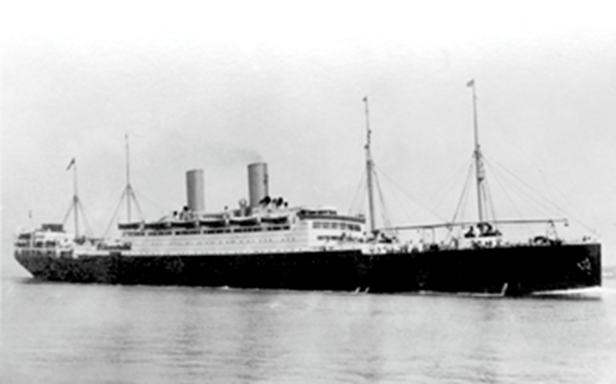
SS Cincinnati

Grandpa Kahles arrived at Ellis Island aboard the SS Cincinnati, pictured above, on June 1st, 1911. He was 24 years old and, while the ship had sailed from Hamburg, he had spent the past six years as a barber in London. The voyage to New York and subsequent journey to Chicago turned out to be his final fling as true wanderlust. Growing up in Sellesch, now Nakovo, a small, rural town in the Austrian-Hungarian Empire (that region is now part of Serbia), he was sent off to Vienna at age 12 to learn to be a barber. His cousin Frank Schwatje had done that as well, and it was a number of years before the young boys would learn to cut hair. They started out running errands, cleaning floors and cleaning toilets. But both became barbers eventually and started to wander. Their travels took them to Switzerland, Paris, and then Belgium. In Switzerland, Grandpa liked to go tobogganing on days off but stopped that practice after realizing that, if he injured his hands, he would have no way of making a living.

Mom believes it was in Belgium that the wandering cousins decided their next adventure with a coin toss. One side of the coin and both would go to China (we have wondered if they knew how the Chinese like their hair to be cut). Well, it wasn’t China. Cousin Frank went to America and settled in Chicago. Grandpa went to London, cut hair, and learned English. In fact, he learned English so well that he spoke it without a German accent. When he was about to come to America, he met someone in Trafalgar Square in London who told him, “Oh, if you are going to America, you should not pronounce your name “Kahles” (with a short “a”-Kaahles), but “Kahles” (with a long “a”- Kayless). So ever after, he did. And that is the origin of our Americanized vs. German pronunciation of Kahles as we knew it in our and our parents’ generation. With his cousin in Chicago, it was inevitable that Grandpa would settle there where he would meet and marry Anna Quint, my Grandma, who came from Bocar, a small village less than 30 km from Nakovo.

Frank Schwatje established a barber shop on Addison Ave. in Chicago, but Grandpa never worked for him. Frank and his wife Lissie (known to mom as Lissie Tante) had three kids, Rosie, Elizabeth, and Mary Jane. Uncle John stood up for the first two at their weddings. Lissie was described as a compulsive housekeeper and shopper, confirmed after her death when they found six trunks of linens in the basement, all unused.

0

Marian Lang’s Family Chronicles – Her Beloved Brother John

May 30, 1993

My Brother, John, was buried yesterday, and a part of my sister-heart with him.  Is it strange to say that part daughter-heart is with my Mom and Dad and certainly; my lover-wife heart will always be with George? A heart must have many facets because I still have much love to share with my family, friends, and you, whoever might care to read this.

As part of the funeral Mass, four speakers eulogized John, each with their own memories of him as an adult. My memories and thoughts went back to our childhood memories of John, the early years with you, if you will. I would share a few.

Mom told me many times over that John was never ever jealous of me when I was born.  I was his little sister and he looked out for me, always.  I like to think that it was never in John’s nature to be jealous or envious of anyone.

My very first personal memory took place on Ward Street in Chicago when I was three years old.  My Mom was talking in German, almost in a whisper.  Translated, “Johnny, Johnny you could have been killed, you have to be careful”. It seems that he had almost been run over by a car. John was six years old and allowed to a play outside. I do not have any of the details, only the memory of that conversation.

John, if anything was always enthusiastic and excited about everything.  He attended Prescott School for the first grade and when the family moved to Belmont Avenue, he was enrolled in the Schneider School. The spring after we moved a baseball game was scheduled between Prescott and Schneider. John burst into the house after the game and was so excited. “Mom, we won” he shouted.  Mom was happy because it meant that he was adjusting to the new school.  Somehow, she must have mentioned Schneider School.  “No, Mom, it was Prescott, when I saw Schneider was losing, I went over to the other side”. True story which was told and retold by Mom and always with a hearty laugh.

John coaxed me to play marbles with him on the living room rug.  He would lay a string in a circle to be the ‘pot’. And he would show me how to hold the marbles and how to shoot.  No matter how hard I tried he always won. When he played with the boys in the dirt, and dirt it was, I could be a spectator.  However, I always rooted for him and was happy when he won some good ‘aggies’.

The kids in our neighborhood were great for flying kites in the springtime.  Hamlin Park ball field was the favorite spot.  I was very young but just old enough to cross Belmont Avenue.  Mom would pack a sandwich and cookies and I would take them in my doll buggy to bring lunch to my brother so that he wouldn’t have to wind in the string and come home. I loved that.  Then he would show me how he sent messages on slips of paper up the string to the kite.

And we would wrestle for fun on the living room floor. Of course, he would always win but eventually I learned a trick.  If I could manage to kneel on his arms and make him laugh, I had it made.

And then there was fudge. I hated fudge. But John wanted to make fudge and had a recipe that called for putting a small amount of the cooked ingredients into cold water for testing.  Something always went wrong with the testing because the candy would have to be recooked in order to harden.  The result was crumbly and sugary but I was coaxed to eat it so he could make more another time.  The first time I made my recipe for ·•Old Fashioned Fudge, I sent him a box and marked it ‘Cooked only once, honest’!

Miss Doerr was our Fourth-grade teacher.  She was a tall, heavy woman and most kids were really scared stiff of her. One day John came home from her grade with all ‘E’s in his subjects and a big red ‘F’ in deportment.  Disaster!  A bad mark in deportment was not tolerated in the Kahles household. When Mom talked to Miss Doerr the teacher told her that John had not misbehaved but that she couldn’t talk to him.  He always cried. So, Mom took John to our family doctor for a checkup.  Dr. Becker prescribed a rest period after school.  It was to be done in just this way. He was to sit in the big, overstuffed armchair with his arms resting on the sides for fifteen minutes before going out to play. John never cried in Miss Doerr’s room again and got good grades in deportment. I like to think that the rest period might have helped, or John began to think that crying was not worth fifteen minutes of play time.

When John was in the seventh grade he cried again. His then girlfriend, Ruth, told him she liked another boy. Elsie Schilling, another classmate, consoled him with the old saying, “There are other fish in the sea”.  And how happy how grateful we all are that John found a magic sea in Cincinnati and there found his beautiful, true love, Bea.  She was and is the love of his life.

And there are many stories of John’s early years. The school yard fights all the way up to the fun of waiting up for each other to talk about our girl and boy parties.

But it is nearing midnight and now my thoughts are of Pearl Buck, the author of ‘The Good Earth’.  After her husband of many years died, she could find no rest, no peace, no consolation.  Finally, after a few years she returned to China where she had spent many years.  There she climbed up a mountain, alone, and when she reached a certain point she sat down and put her back against a warm rock.  She wrote that she sat there for a long, long time and finally found peace.  I like to think that we must all find our own warm rock, whatever that may be, to find peace within ourselves.

There is a rock waiting for me to heal the hurt of John’s death. I don’t know where or what it is.  I only know for certain that it is there, and I will find it.

I loved him.  Marian (Babe) John’s sister.

0

Marian Lang’s Family Chronicles – Anna Quint Comes to America

The Chronicles Resume

February 20, 1989

To the Readers of the Family Chronicles:

It has been a while since I have written about Mom, her relatives, and her early family life.  I would like to take a little time to digress and “talk” to you, if you will.

It is Mom’s Birthday today, a gray and snowy day here in the Midwest.  I wondered what it was like weather-wise in Bocar the day that Mom was born and what care and comfort was afforded Grandma Quint when the baby was born. Just thoughts of mine on this day.  Catholics have a tradition of praying for the souls of the dead.  I prayed for Mom as I do every day, but this day I offered my prayers at Mass.  A candle was lighted at the altar for the peace of her soul.  I think she would have liked that, but if not, certainly the ritual was a comfort to me. I miss her so much.

Peggy and John Lewis along with Susan Kahles visited with me yesterday. No Gram-goodies for them but I did make Susan’s favorite cherry coffee cake which they enjoyed with tea and coffee.  Quite a bit of the conversation centered around their experiences with Mom.  We all agreed that it is not realistic to beatify the dead. Mom, great though she was, had her faults and failings. I’m sure that at a future time they will find their way into the record.

Changes are taking place in the Kahles and Lang families. Peggy is organizing a Kahles family newsletter which will keep us up to date.  It is possible that Dick might incorporate some of them into the Family

Chronicles. As for the Lang’s, Dick and Leslie’s son, Doulas is now a sophomore in college. Jan1ce will graduate from high school in June Kenyon, George, and Mary-Beth’s son, is in Prep School and Susan Quint will soon be twelve years old. The exciting news of 1988 was the arrival of Gina Elizabeth, a Korean born baby, who is being adopted by Mari and Jerry. She arrived at O’Hare Airport on September 19th, just five months after her birth on April 19th.  She is an adorable sister for Sean, eleven years old and Drew who is seven.  What a precious gift for the whole Lang family.

When I began writing about Mom a little over a year ago, I was preparing to “jelly” the Vanilla Grentzla. It is that time aga1n.  I just finished baking the cookies and now it is time to put the cookie halves together with the jelly.  They are going to be sent to Mary Beth in her Birthday box. Verbalizing love is absolutely essential and wonderful but sometimes I think my kids enjoy having love expressed in the form of cookies ‘n stuff.

Okay, Dick, you told me that I am always moralizing. Sorry, can’t help it, it’s just me.

Love,

Anna Quint Comes to America

January 27, 1990

Dear Dick

It has been almost a year since I have written for the Family Chronicles.

I must tell you about ·Theresa White.  Theresa is a widow friend of mine, a teacher of special education in the Chicago school system.  After her husband died, she was caught in a position of almost uncontrollable grief along with family concerns.  After a time and with the encouragement of her children she decided to continue her graduate studies.  She was awarded her PhD in Education last May.  We were conversing one time when I told her about my effort to write my Mother’s memoirs.  I met her the other day and she asked me how I was coming along with the writing.  I told her that it had been a while and that Mom was on Ellis Island.  She urged me to get on with it and I said I would.

A psychiatrist would not find it too difficult to diagnose the reason for the procrastination.  It has not been that I have been too busy. My everyday life is busy and during this last year, I have again enjoyed the camping season and my trip to Europe. I had wanted for a long time to experience Michelangelo’s Sistine Chapel, to spend at least a little time in the Louvre, and to stand in the Square in Florence.

All that, yes.  But this evening after some soul searching and a few tears I realized why Mom was still on Ellis Island.  With her arrival in America, it would become a time when her life and mine would intertwine.  Our love for each other was very strong and losing her has been painful.  The memories might be difficult to record.

Well, painful or not, I can’t leave Mom on Ellis Island for the second time, especially since the first was not too happy.

Sixteen-year-old Anna Quint travelled alone, steerage class, for almost three weeks.  Seas were stormy and she really didn’t know which was worse, the continual seasickness or the homesickness.

As an immigrant she came with her clothes tagged with her destination and one rattan suitcase holding her only possessions.  She cried most of the way.

November 2nd, 1909 is recorded as her arrival date on Ellis Island. An immigration officer trying to transfer her suitcase to the train bound for Philadelphia was met head on by a very determined Anna not to be separated from her only possession.  A tug of war took place with the case between Anna and the officer.  Finally, exasperated he pushed the case to her and said, “Get the hell out of here”. She understood. Welcome to America, Anna.

Love,

Ann Quint – Philadelphia and Chicago

February 20, 1992

Dear Family

Dick Lang, Susan Kahles, my friend Theresa White have all been urging me to continue with “Mom’s Story”. A few days ago, Tribune columnist Bob Greene wrote an article urging all parents to record family stories but also interesting bits and pieces of their own lives. Perhaps I will do so someday.

So here it is February 20th, 1992, Mom’s 99th Birthday.  I went to Mass this morning to offer it up for her joy and peace and to light a candle.  I whispered a “Happy Birthday from all of you and a tear from me.

Well, on with it.  The last effort left Anna Quint on Ellis Island.

Anna was put on the train, her destination Philadelphia noted on the tag pinned to her clothing.  She was met at the train station by her Sister, Maria (Marta Tante) and the family with whom she was going to live as a domestic. Their name was Gleich.  Mrs. Gleich was a warm-hearted Jewish lady who took Mom into a loving family home.

Mrs. Gleich took this tiny homesick sixteen-year-old girl, exhausted after three weeks of ocean travel in steerage and promptly put her to bed.  She covered her with a warmed blanket. Warmed is important because it must have seemed like heaven to Anna.  Mom never talked about The Gleichs without mentioning the warmed blanket.  Years and years have passed but I still like to imagine Mom cuddled up in that warmed blanket.

Originally Anna was hired to talk German to the Gleich children and to do some 1ight housekeeping chores. However, it didn’t take the family long to discover that Anna was an excellent cook, and to marvel at the wonderful strudels, kuchens, tortes, breads, and pastries that she made for them.

She was happy with the Gleichs. She saved every penny she earned until she had enough to repay the money paid for her passage to this country. After the debt was paid the first thing, she purchased for herself was a blouse. On her free day, Thursday, she would meet with her cousins Christine, Elizabeth, and her sister.

I’m not sure just how long Mom lived with the Gleichs but one day there came a time of decision.  Her sister returned to Europe to be married to John P. Lux. John’s sister, Emmie Boesa lived in Chicago so after the marriage the newlyweds returned to the United States and settled in Chicago. Mom wanted to follow her sister to Chicago.

When she arrived in Chicago she went to work for a family by the name of Britton. The Brittons lived on the Gold Coast and Mom was hired to be a cook. The family consisted of the Mother, Father and two teen age sons. The family budget was very rigid when it came to the purchase of food and the Britton boys were always hungry. On Sunday, one roasted chicken was carefully carved, one piece placed on each plate with no seconds. The leftovers were served the next day soup made from the bones.

However, it wasn’t as Spartan as it seems. Mrs. Britton was a sister of one of the Wielands of the Wieland Dairy Company of Chicago. The Wielands supplied the Brittons generously with mi1k, cream, cheese.and best of all, whipping cream. Mom loved whipped cream and would eat the dessert before the meal was ready to be served.

On Thursdays, maid’s day off, she would visit with her sister and her husband. John Lux was a janitor for an apartment building 1ocated on LaSalle Street and he and Marta Tante lived in the basement apartment.

I’m not sure how much time was spent in the flat on Southport Avenue because sometime between May 19, 1913 and September 1914, Dad had purchased a barber shop which was located at Montrose and Damen Avenues in Chicago.  It was there that John Frank Kahles was born on September 11, 1914.

Kahles Family Moves to Renville, Minnesota

A sad time followed about the time that John was six or seven months old.  Dad suffered a nervous breakdown which followed some minor surgery.  Mom took care of John, cooked for the barber who was employed at the shop and visited Dad in the hospital.  Following his stay in the hospital and keeping appointments with his doctors he was advised to leave his trade. He was told to go out into the country and work in the fresh air.

The barber shop was sold, and they moved to Renville, Minnesota where other friends and Landsleute had located. They rented a farmhouse. There was a large garden and room for chickens and a cow.  Gram also raised a little pig. To earn money, they hired out to farmers in the area.  The principal crop was sugar beets. The beets were picked by workers crawling on their hands and knees between the rows.  Along about this time Mom became pregnant with me which she always said was what she really needed at the time. However, as her pregnancy progressed, she decided that it would be nice to have another boy who would be a companion to John. She could always picture, the two little boys dressed alike. No wonder then that she delighted in sewing matching suits and clothes for my boys, George Jr., and Dick Lang. But as fate would have it the baby turned out to be a girl, Marian. I was born on December 6, 1917, Renville, Minnesota.  Mom said the temperature was 44 degrees below zero and the chickens had to be brought indoors so they wouldn’t freeze.

There has been some confusion about my name.  The Doctor’s Certificate lists my name as “Maria Anna”.  Mom said a neighbor visited her while she was still in bed after giving birth to me. She asked about my name and when told, “Ach, that’s too long for a baby, put the two names together and call her “Marian”. Fast forward to my application for a passport.  Doctor’s Certificate not legal.  Application sent to Minneapolis.  The returned legal document lists my name as “baby”.  But I was baptized in the Catholic Church in Renville.   My certificate lists my name as “Marian”. So it is!

0

Marian Lang’s Family Chronicles – Anna Quint and Her Siblings

I will try to tell you a bit about Mom’s brothers and sisters. Grandma Quint bore ten full term children and a premature still born girl.  They were:

Anton

Christian

Elizabeth

Johann

Lenchie (Magdalen)

Nicholas

Frantz

Maria (Marta Tante)

Margit

Anna (Mom)

Anna

Anton, the eldest Quint child died at the age of ten as a result of diphtheria.  His death broke Grandpa Quint’s heart and Mom said he never reconciled himself to that loss. Christian and Elizabeth died in infancy. Johann and Lenchie were very much a part of Mom’s childhood as was Maria.  John and I knew Maria as Marta Tante, who, by the way, was my Godmother.  Then there was Margit, two years older than Mom, a whiner and spoiled child.

Grandma Quint and Her Pilgrimage

Nicholas and Frantz were retarded.  This was a very serious burden on the family.  Mom was not sure of the degree of retardation, but she understood that there never was any hope of the children reaching adulthood.  Grandma Quint was a very devout woman and prayed to the Blessed Virgin to take them to heaven. If that should come about, she promised to join a pilgrimage to honor Our Lady on one of her special feast days.  The boys died.  By that time Maria had already been born.  One day forerunners came to Bocar announcing the fact that folks from distant villages were coming through on a pilgrimage to honor the Blessed Virgin.  Remember, no telephones, radios or TV news and no time for elaborate preparations.  Grandma, true to her promise, hurriedly made arrangements for her family, gathered some food and clothing in a bundle and prepared to join the pilgrimage.  It was a three day walk to the Cathedral.  Pilgrims walked all day and at night were allowed to sleep in barns or townspeople would put them up for the night if they had room in their homes.  But Grandma had another problem.  Maria was still nursing, and it was very important for Grandma to “keep her milk”.  In order to do that she nursed babies on the way. Although Grandma was able to leave her family with relatives, there were others who had to carry their infants along with them. When Grandma returned home, after all her effort, she found that Maria absolutely and in no way was going to nurse again.  Mom said she was stubborn even then!

Anna’s Baby Sister – Anna

Grandma Quint stretched her leg out from under the down comforter to rock the wooden cradle next to her bed. The child being rocked was Mom and her very earliest memory was that of being lulled to sleep by her Mother pushing the cradle with her foot.  She was still a small child at about two and a half years of age and probably still fit nicely into a cradle.

Also firmly engraved very early in her memory was the birth of her premature still born sister.  The baby was named Anna.  Mom could never understand just why her parents named her Anna, but that is what they did.  An Uncle made a tiny wooden casket for the preemie and she was waked in the home. Big Sister Anna, not even three years old knelt in prayer in front of the casket.  She felt very, very important and even when she grew old, she could still recall that feeling.

Most children unless their parents were wealthy did not own a “real” doll. Their dolls were made of bits and pieces of cloth or wood.  The little preemie was tiny and beautiful, and Mom distinctly remembered asking if she couldn’t keep her for a doll.  Grandma Quint cried and when Mom grew older, she could understand the reason for the tears.

Anna at the Ovada

I’m not sure that you have ever heard the word “Ovada”. I enjoyed hearing Mom talking about the Ovada and when I was little, I liked to say it out loud.  Try it, it is a soft sounding word, as compared to the rather brittle sound of “kindergarten”.

The Ovada was a sort of pre-school since children were enrolled at the age of four.  When they were six years of age, they began their six years of formal schooling.

It must have been a very pleasant time for Mom because she referred to the Ovada in a loving way. Of course, being a Quint, she was very bright.

Just kidding! No, when I think about it, I really am not because I have a little cup which she won as a prize for being the brightest in her class.            She treasured this cup, and it has been broken and mended a number of times.  Many years before she died, she gave it to me to treasure.  And I do.

I would sometimes visit when Mom took her turn to entertain the Bunco Club.  A number of the ladies in the club would tell me that they had gone to the Ovada with Mom.  I just knew that they had never won a prize cup.   Atta girl. Mom!

Anna’s Recitation Dress

Once a year around Christmastime all the school children were invited to the home of the Countess. It was a very special time because each child would receive a small sack of candies and nuts as a treat.

As part of the entertainment, Mom, now in about the first or second grade, was chosen from her class to give a recitation. She practiced diligently at home.

Mom’s school clothes consisted of her sister Margit’s hand-me-downs.  They were clean but often patched up here and there.  However, on the day of the party she was to wear a nicer dress.  The arrangement was made for her to go back home to change.  When the time came for her to do so and she hadn’t arrived, Grandma Quint panicked. She brought the nicer dress to school and not finding anyone there ran hurriedly to the home of the Countess. She entered the home just in time to see Mom, in her patched-up clothes, standing proudly on the stage in the ball room giving her recitation in a loud and confident voice. Grandma was really embarrassed. It must have caused an argument in the house because Grandpa Quint said that Mom could have a “new” dress for once.  She was allowed to choose the material and remembered that it was as she put it, really’ cheesy, certainly not meant for long wear.

Typhoid Fever Strikes the Girls

One year typhoid fever was rampant throughout Bocar and neighboring villages.  If I’m not mistaken it was a result of unusual flooding in the area.

Two of the victims of this terrible fever were Mom and her sister, Maria (Marta Tante).  They were very ill, and both drifted in and out of consciousness for many days.  Marta Tante was six years older than Mom and though Margit was only two years older it seems that she was not ill or perhaps had a milder case of the disease.

At one point it was not certain that the little girls would live.  Katy, Mom’s Aunt, came to visit. In a hushed voice she talked to Grandma Quint and said, “If one of them has to die, it would be better for the little one to go because the older one can be more helpful”.  Mom said she heard this and was so angry that she determined to get well.  She blinked her eyes and her horrified Aunt said, “I think she heard me”. Indeed, she had and Mom always attributed her will to conquer illness to that specific time in her life.

The girls lost all of their hair as a result of the high fever.  Grandma Quint crocheted little caps for them to wear when they were able to go back to school.  Their hair grew back curly!

A Sprinkling Can that Never Arrived

We have all heard the story many times over about Mom’s most bitter disappointment.  Of course, it was about the sprinkling can.  When Susan and I talked about writing a few things about Mom’s life, she said, “And don’t forget about the watering can”. No, Susan, it was never a watering can, always a sprinkling can.

But for the sake of this little effort let us recall that Grandpa Quint was a rope maker.  At various times of the year markets were held in neighboring villages.  Tradesmen and farmers would gather from many miles away to sell their produce or their wares.  And Grandma and Grandpa Quint would travel by horse and wagon to show and sell his ropes.

Before they left on one of their treks, they promised Mom that when they returned, they would bring her a sprinkling can.  They were gone several days, and Mom waited almost nervously for their return. The time finally came but there was no sprinkling can for her.  She was crushed.  It was almost a tragic disappointment and I sometimes wonder if she ever quite forgave her parents.

You all know that story because Mom never forgot. After she retold it the final line was always this.

“I never promised my children anything I couldn’t keep, including a spanking”.

The Curious Case of the Prized Pear

Mom was not the only Quint to experience disappointment.  For many years Grandpa Quint nurtured a certain kind of pear tree.  The tree was healthy but just did not bear fruit.  Lo and behold, one year the tree rewarded his efforts with just one beautiful, huge pear.

He picked it while it was still green and placed it high on the rim of the big white oven to ripen. When it became ripe, he promised to cut it into slices and share it with the family.

Guess you know the rest. Mom could not wait and every now and then she would steal a bite from the back of the pear.  Eventually only one half of the fruit remained and that was not too nice from the inside.

One day Grandpa reached up to exam his prize pear!  I have no ending to the accounting of Mom and the Prize Pear. I can only add that she never mentioned being punished. However, I think she was because she remembered that particular pear forever.

Anna and Maria Work for the Countess

After six years of formal schooling, when she was about twelve years of age, Mom was sent to work as a maid in the household of the “Grafin” which translated means Countess. This Countess lived in a neighboring village. I cannot recall if it was Beodra or Zsgedin, but whatever. Her sister, Maria, was already working in the same household as a cook. I can’t say much about her experiences there except that she was terribly homesick and was happy that her sister was there.

But sisters being sisters, eventually a little cattiness would leak out.  Mom would say that the people liked her much better than her sister because Maria was “really fresh”.  Maybe good cooks were hard to come by and so they tolerated her sassiness. Another comment always followed. Because Maria was a cook, she never had to wash the cooking or serving dishes. Mom said she was spoiled in that regard. Even as a child and later as a mature woman, I know that Marta Tante was the most fantastic cook, but wow the sink was always stacked. I love you, Marta Tante, but for the record I just had to write this.

Death of Grandpa Quint

Mom did not serve at the Countess home for very long when she was called home to help Grandma Quint to take care of Grandpa who had taken very ill.  He was ill for several years with what Mom thinks were ulcers of the stomach. She relieved Grandma of many chores, worked hard in the wheat fields, tied up vines in the vineyard, worrying about and praying that her Father would get well.

Grandpa grew progressively worse and finally became bedridden. One night when Mom was about fourteen years old, she was awakened in the middle of the night and told her Father was dying. The Priest had been summoned to administer the last rites.

I’m not sure if Margit was home at this time but Maria was already in America.  Lenchie and Johann were both married and living in Budapest, Romania.

Relatives who lived nearby had been called together and when the Priest arrived, they carried lighted candles and accompanied him into the sickroom.

When Grandpa saw the Priest, he realized that he was dying. Tears rolled down his face and sadly he looked around the room to silently say farewell to his loved ones.

That tearful, pitiful look on her Father’s face etched itself permanently into Mom’s memory.  As a result of this sad experience, Mom could never reconcile herself to the concept of administering the Sacrament of Extreme Unction to a dying person.  As for herself, she felt it had been cruel to awaken a young person out of a sound sleep to witness the death of a loved one. It is possible to argue this point in many ways, but the final result is that this was her personal feeling on the matter.
0

Marian Lang Family Chronicles – Before Anna Quint

And so we begin.

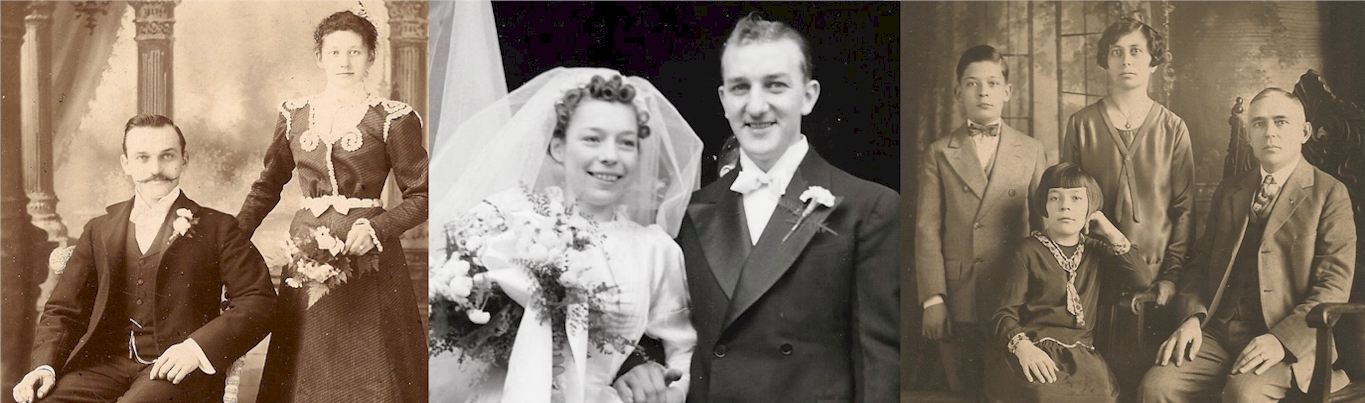
It would be helpful if you would refer to the copy of the family tree that we have provided for you.

You will see that Anna Quint was born in 1893. She was the youngest of ten children.  Her Mother, Maria, bore a premature still born girl about two and a half years after Gram’s birth.

Her Father, Joseph was a rope maker and as is the custom in many European countries she came to be known as Anna, the rope maker’s daughter. I am not certain of the spelling, but she was known to her relatives, neighbors and even the “Landsleute” here in America as “Sahler’s (sic – it’s Seiler) Anna” which is the way she always pronounced it. She told me that many people would not have recognized her by her legal name.

John and I are going to try very hard to recall some of the events in the life of Mom.  But where to begin?  From the time that we were little children she would recount stories of her childhood, per parents and relatives.   They were retold at various times of our lives.   At the time they seemed so fragmented and many times we were not too interested. However, the difference between childhood and growing up meant that I came to appreciate and marvel at the courage and stamina, physical and mental, of this woman who was my Mother and my friend.

MARIA HARTER QUINT AND HER SIBLINGS

Mom often talked about her Mother and her relatives, so I think it is important to write a few things about them.  Maria Harter Quint was our Grandmother, the second child of Susan Winter Harter.  Katy was Susan’s eldest, followed by Maria, Christine, Jacobin, and Hans.

Susan Harter was a young widow. She remained so for over thirty-five years.  Mom always added the fact that she already had five children when her husband died, the inference being that had she remarried she surely would have borne ten or twelve.

One of Mom’s favorite stories concerns the birth of Katy, her Aunt.   Katy was born with a caul.  The superstition of the time was that being born with a caul would bring the child a great deal of good luck.  Mom often thought that since the caul was around the baby’s head and face. Perhaps the fact that it survived at all was lucky indeed.  However, as a result of this superstition, Grandma Harter carefully observed the caul and saved it until Katy’s wedding day.

Katy’s wedding day is another story.  You must appreciate the fact that in the small villages of Europe at the time, there were no Marriott, Hilton, or bridal suites in which to spend one’s wedding night.  After the festivities, the newly married couple would often spend their wedding night in the family home.  Now it seems that Katy was reluctant to go to the bridal bed and no amount of coaxing by the groom would change her mind.

Finally, Grandma Harter, tired of the whole scene, enlisted the aid of our Grandma Maria to trick Katy into the bedroom.  Maria went into the bedroom, called her Sister on some pretense and when Katy was safely inside our Grandma bolted out of the door and the groom slipped in. Grandma Harter locked the door from the outside.

When Grandma Harter was preparing the bridal bed, she placed the caul, which she had carefully saved all through the years, under the bride’s pillow. However, before the honeymoon began, the family cat found the caul, ate it, and died.

Katy had bad luck all through her life.

This brings us up to Grandma Harter’s third child, Christine.

I always enjoyed Mom’s imitation of what I would call “Christine’s Complaint”. It was expressed frequently and always with exactly the same wording.

In order to commiserate just a little with Christine we must consider the role that dowry played in the social and economic structure of the time.  As Mom always said, in Europe when she was growing up, what a young couple brought to the marriage often proved to be the only material things that they enjoyed during their entire married life.  So, dowry was quite important.

Christine had a sweetheart. The way I understand it was real love and not the manipulation of the village matchmaker.  Oh yes, the matchmaker figured prominently in the marriages of the day, including that of Maria Harter and Joseph Quint.  Surprised?  Mom often told me about it.

But to get back to Christine.  Christine and her sweetheart were anxious to be married but because her sister, Maria, was older and still not married she would have to wait until a husband was found for her. Enter the matchmaker who found a prospect for Maria. Maria really did not want this man but there was another obstacle. Since Susan Harter was a widow, the important dowry was rather questionable.  This did not suit the first prospect, so he bowed out of the picture.  The matchmaker then contacted Joseph Quint. Maria liked him much better, and they agreed to be married.  This was also agreeable to Grandma Harter because Joseph was not as demanding concerning the dowry.

What has all this to do with “Christine’s Complaint”? Well, when older sister Katy was married, Grandma Harter was able to give her a cow for her dowry.  Maria was fortunate to receive a calf but there was nothing left for Grandma Harter to give to Christine.

Love conquered all and despite the lack of dowry the young couple were married.

Human nature is often petty and perhaps when the first blush of romance began to fade, Christine began her oft repeated complaint.

I can still hear Mom do this great imitation of the voices of the two sisters.  Christine complaining to Maria, “Ja, Katy hat ein kuh, du hast ein kalb und ich hab nichts”.  To which Maria would always patiently reply, Aber Christine, die Mutter hat nicht kenna”.

Aside:   And I can imitate Mom.

Jacobin, ‘Pronounced “Yah-ko-bin”, was Susan Harter’s fourth child.  I can’t recall Mom ever mentioning the fact that she was married.  She might have been, or it is possible that she worked in another village as a domestic.

What I do remember is that Mom always referred to her as Die Arme Jacobin”.  When I would ask her what she meant by that she would always say “She was a poor thing, followed by “And so poor”. I gathered from that statement that Jacobin was not only poor but was not very bright.

Jacobin would walk many, many miles from a neighboring village on Sundays hoping that her sisters would give her something to eat.

It was very important that food be conserved and most times it was not generously shared.  One of the means of a family surviving financially was to save on food.

Boys were apprenticed to the trades at the age of twelve and young girls were sent to be domestics in the homes of the “Herrschaft”.  Many times, this was necessary simply to “Get them off the table.”

Jacobin would make her appearance on Sundays and Grandma Quint would grumble but Grandma always managed to give her something to eat.  She made sure that Jacobin would leave with a small package of food to sustain her on her long walk back home. I sometimes wonder if Jacobin wasn’t brighter than everyone thought.

I am sorry that there is nothing to be written about Hans, Susan Winter’s fifth child.  Mom never mentioned him except to say that he was the youngest of the family.

The infant mortality rate was very high, and it is possible that he never survived childhood.  Whatever the reason, Hans will remain an enigma.  It’s not much but at least he has a mention on these pages.

ANNA QUINT’S GREAT GRANDMOTHER – FRAUENHOFER

I must back track here to tell you about Mom’s Great Grandmother Frauenhofer.  Susan Winter told it to Grandma Quint who in turn told it to Mom.

You will recall that we talked about “getting off the table”. It meant almost literally being pushed out of the house in order to save food.

Great Grandmother Frauenhofer was forced to marry at the age of fourteen. She objected violently to this arrangement but to no avail She would get out of the house and “off the table”. We might smile and think that perhaps the young girl had a healthy appetite but to her it was no joke. Could it be that the prospective bridegroom put a gift of value on the table in exchange for the girl?

She had no choice.  She was married.  Her new husband took her to another town to live with his Mother. The Mother now had a young girl to do most of the work around the house.  The young bride was extremely homesick and often slipped out of the house to chum around with the young girls of the neighborhood. This, of course, did not suit the old witch who scolded her constantly and reminded her that this sort of behavior was not suitable for a “married woman”.

Before the age of fifteen she became a Mother. When we consider the great number of teenage pregnancies today that would not seem outrageous.  It was scandalous at the time. She cried and cried as she cradled her newborn daughter.  Her lullaby?  “Du braughst nicht heiratten”. Translated, “You do not have to marry”.

0

Marian Lang Family Chronicles – Forward

THE FAMILY CHRONICLES

FORWARD

On 4 December 1987, two days before Mom turned seventy. George and I flew to Chicago as a surprise for her birthday. That evening, Jerry and Mari led Mom into the Black Forest restaurant where George and I were waiting. It was immediately evident that the surprise was a great success and that stories of the occasion may be told for years to come. How many years? It would be hard to say since the only family historian of any kind, now seventy, kept all the data in her head.

With that thought in mind, I decided to urge Mom once again to write down her recollections of the family histories and stories of the Lang, Kahles, Quint and other clans as may be appropriate. My latest strategy is to convince her of the magical powers of my word processor which would allow me to be editor and publisher of the chronicles, thus freeing her to concentrate on the task of initial authoring. She could type out any story or historical segment of any family from any time period which happened to move from the long-term archive sector of her brain to the active task sector. After a core dump to hard copy of any logical record of family history data, she would send it to me for entry into my computer system. At appropriate intervals, I will match/merge or otherwise append and/or concatenate like records to assemble the chronicles in correct order.

Wish us luck on this joint venture. It may well be a long haul to completion, but I for one am excited about the thought of recording the family history and publishing it for posterity and the enjoyment of all. During the process, of course, I would welcome comments on my periodic updates and would also expect interested family segments to embellish the core chronicle with their own additions.

Richard F. Lang

December 20, 1987

Dear Mom:

I feel especially near you today as I know you are to me in a very special way. I am cutting out the Vanilla Grentzla, getting them ready to send to George and Dick. I have your cutter that Uncle Karl, your cousin, made for you in his tin smith shop. In a while I will have to put the cookie halves together with the jelly. You really did not like doing that! I never minded. I remember coming home to “do the jelly”. We talked about many things, had tea, and enjoyed our time together.

Susan spent the day with me last week and Jerry joined us for dinner. I made your Kaese Palatschinken for them. I especially wanted to serve something you might have made for them. It followed naturally that we would talk about you. Your grandchildren and your great grandchildren have their own special memories of you, as do I. However, they would like me to try to recall some of the stories you told me about your parents, relatives, your childhood and perhaps even your early married life. So, it seems that I’ve been elected the clan storyteller. I will try my best and ask John to help me.

Love you,

Marian

0

The Donauschwaben

Wait! I thought we were German. So why talk about Serbia? And what does Yugoslavia have to do with my maternal grandparents Franz Kahles and Anna Quint? To answer these questions, let’s start with a little Wikipedia history lesson.

The Danube Swabians (in German – Donauschwaben – (doe’-now-schwaben)) is a collective term for the German-speaking population who lived in various countries of southeastern Europe, especially in the Danube River valley. Most were descended from 18th-century immigrants recruited as colonists to repopulate the area after the expulsion of the Ottoman Empire.

Because of different historic developments within the territories settled, the Danube Swabians cannot be seen as a unified people. They include ethnic Germans from many former and present-day countries: Germans of Hungary; Satu Mare Swabians; the Banat Swabians; and the Vojvodina Germans in Serbia’s Vojvodina, who called themselves “Schwowe”in a Germanized spelling or “Shwoveh” in an English spelling; and Croatia‘s Slavonia. In the singular first person, they identified as a “Schwob” or a “Schwobe”. Wherever I heard my mother, Marian Lang, speak German I would tell her that she spoke German like a Schwob. She would reply: “That’s because I am a Schwob.”

Origins

Beginning in the 12th century, German merchants and miners began to settle in the Kingdom of Hungary at the invitation of the Hungarian monarchy. Although there were significant colonies of Carpathian Germans in the Spiš mountains and Transylvanian Saxons in Transylvania, German settlement throughout the rest of the kingdom had not been extensive until this time.

During the 17th-18th centuries, warfare between the Habsburg Monarchy and the Ottoman Empire devastated and depopulated much of the lands of the Danube valley, referred to geographically as the Pannonian plain. The Habsburgs ruling Austria and Hungary at the time resettled the land with people of various ethnicities recruited from the Austro-Hungarian Empire, including Magyars (Hungarians), Czechs, Slovaks, Croats, Serbs, Romanians, Ukrainians, and Germanic settlers from Swabia, Hesse, Palatinate, Baden, Franconia, Bavaria, Austria, and Alsace-Lorraine. Despite differing origins, the new immigrants were all referred to as Swabians by their neighbor Serbs, Hungarians, and Romanians. The Bačka settlers called themselves Schwoweh the plural of Schwobe in the polyglot language that evolved there. The majority of them boarded boats in Ulm, Swabia, and traveled to their new destinations down the Danube River in boats called Ulmer Schachteln. The Austro-Hungarian Empire had given them funds to build their boats for transport.

Settlement

The first wave of resettlement came after the Ottoman Turks were gradually being forced back after their defeat at the Battle of Vienna in 1683. The settlement was encouraged by nobility, whose lands had been devastated through warfare, and by military officers including Prince Eugene of Savoy and Claudius Mercy. Many Germans settled in the Bakony (Bakonywald) and Vértes (Schildgebirge) mountains north and west of Lake Balaton (Plattensee), as well as around the town Buda (Ofen), now part of Budapest. The area of heaviest German colonization during this period was in the Swabian Turkey (Schwäbische Türkei), a triangular region between the Danube River, Lake Balaton, and the Drava (Drau) River.

After the Habsburgs annexed the Banat area of Central Europe from the Ottomans in the Treaty of Passarowitz (1718), the government made plans to resettle the region to restore farming. It became known as the Banat of Temesvár (Temeschwar/Temeschburg), as well as the Bačka (Batschka) region between the Danube and Tisza (Theiss) rivers. Fledgling settlements were destroyed during another Austrian-Turkish war (1737–1739), but extensive colonization continued after the suspension of hostilities.

The late 18th-century resettlement was accomplished through private and state initiatives. After Maria Theresa of Austria assumed the throne as Queen of Hungary in 1740, she encouraged vigorous colonization on crown lands, especially between Timișoara and the Tisza. The Crown agreed to permit the Germans to retain their language and religion (generally Roman Catholic). The German farmers steadily redeveloped the land: drained marshes near the Danube and the Tisza, rebuilt farms, and constructed roads and canals. Many Danube Swabians served on Austria’s Military Frontier against the Ottomans. Between 1740 and 1790, more than 100,000 Germans immigrated to the Kingdom of Hungary.

The Napoleonic Wars ended the large-scale movement of Germans to the Hungarian lands, although the colonial population increased steadily and was self-sustaining through reproduction. Small daughter-colonies developed in Slavonia and Bosnia. After the creation of Austria-Hungary in 1867, Hungary established a policy of Magyarization whereby minorities, including the Danube Swabians, were induced by political and economic means to adopt the Magyar (Hungarian) language and culture.

With the treaties ending World War I, the Banat was divided between Romania, Yugoslavia, and Hungary; Bačka was divided between Yugoslavia and Hungary; and Satu Mare went to Romania. In Yugoslavia, the death of Tito (1980) gravely weakened communist rule, and the waves of liberation washing over other parts of the communist world in the late 80’s and early 90’s led to the dissolution of the country. Croatia, Slovenia, Serbia and Montenegro, and Macedonia, all became separate states.

I will update this post with maps that provide a time-phased view of the changing boundaries and kingdom/country names over the centuries and show the country or empire our family of Danube Swabians belonged to during these different times.

Culture

The Danube Swabian culture is a melting pot of southern German regional customs, with a large degree of Balkan and mostly Hungarian influence. This is especially true of the food, where paprika is heavily employed, which led to the German nickname for Danube Swabians as “Paprikadeutsche”. The architecture is neither Southern German nor Balkan but is unique to itself.

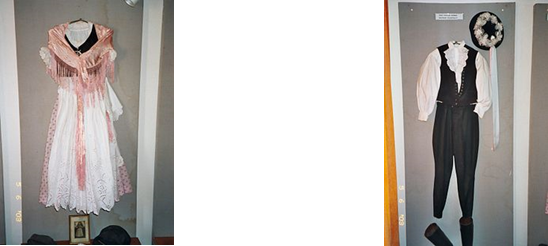
Danube Swabian Clothing

Language

The Danube Swabian language is only nominally Swabian (Schwowisch in the Bačka). In reality, it contains elements or many dialects of the original German settlers, mainly Swabian, Franconian, Bavarian, Rhinelandic/Pfälzisch, Alsatian, and Alemannic, as well as Austro-Hungarian administrative and military jargon. Loanwords from Hungarian, Serbian, or Romanianare are especially common regionally regarding cuisine and agriculture, but also regarding dress, politics, place names, and sports.

Many German words used by speakers of Danube Swabian dialects may sound archaic. To the ear of a Standard German speaker, the Danube Swabian dialect sounds like what it is: a mix of southwestern German dialects from the 18th century.

Popular names for women include: Anna, Barbara, Christina, Katharina, Magdalena, Maria, Sophia, Theresia, and many two-name combinations thereof. Popular names for men include: Adam, Anton, Christian, Friedrich, Georg, Gottfried, Heinrich, Jakob, Johann, Konrad, Ludwig, Mathias, Nikolaus, Peter, Philipp (or Filipp), and Stefan (or Stephan). With so few names in villages, other modifiers or nicknames were almost always used to distinguish people.

We’ll rejoin this region later in the family story when we learn about mom’s second cousin, Anton Letang, and what happened leading up to and during World War II.

0

Kahles and Quint Home Towns

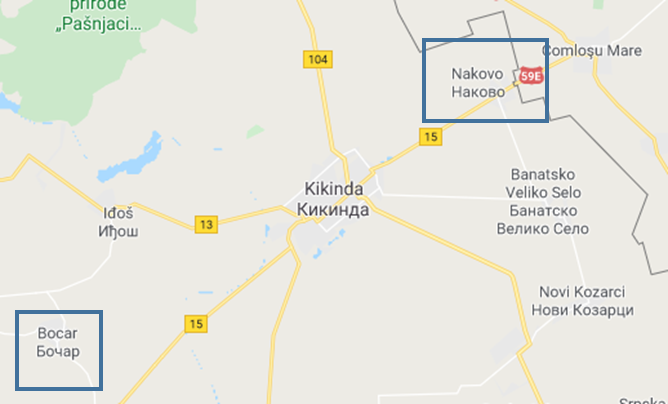
“Where did we come from?” is probably the most asked question about family history. So, here’s a map showing where Franz Kahles and Anna Quint were born.

Franz Kahles came from a village in the northeast corner of present day Serbia called Nakovo. When he lived there, many people still called it Seles or Sellesch as it been known for centuries during the Middle Ages. While the village name changed once, the countries and kingdoms to which it belonged changed more often as did the ethnicities of its inhabitants. Ethnic Serbs lived there when it belonged to the Ottoman Empire during the 16th and 17th centuries but by the first half of the 18th century, the village no longer existed and the area was uninhabited.

Becoming part of the Austro-Hungarian Empire, Sellesch was resettled by Greek traders, the Nako brothers (hence the current name) in the late 1700s. The brothers built houses for their ethnic Hungarian labor force. German families then settled in the village in 1790 as the Hungarians departed due the harsh conditions.

After World War I, the village became part of the newly formed Kingdom of Serbs, the future Yugoslavia. During World War II it became a German occupied region. Most of the German population fled the village late in the war and those who didn’t were sent to prison camps. After the war, Serb families from Bosnia came to populate the village. Yugoslavia then broke up into its six republics due to political upheavals and conflicts during the early 1990s. Thus, the village of Nakovo is now part of Serbia.

Anna Quint was born in the village of Bocar (In German: Botschar, Butch’-are) about 12.5 miles from Kikinda. There doesn’t seem to be a lot written about its history.

The maps below will help you pinpoint these villages.

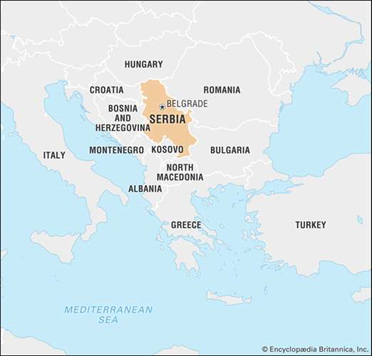
Serbia is in the central Balkans
Serbia with Area Insert
Anna Quint: born in Bocar. Franz Kahles born in Nakovo

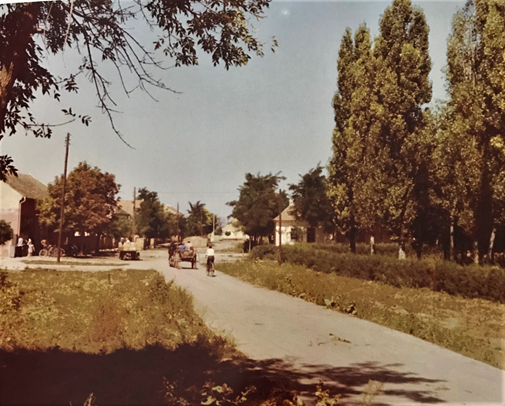
Here are photos of Nakovo and Bocar. I will update this post with an explanation of how ethnic Germans came to populate this area of the world, and why we’re called “Donauschwaben” (Doe’-now shwab’-en) in German or Danube Swabians (Sway’-biens) in English.

Street in Bocar
John Kahles in Nakovo

0

Mom and Sailors

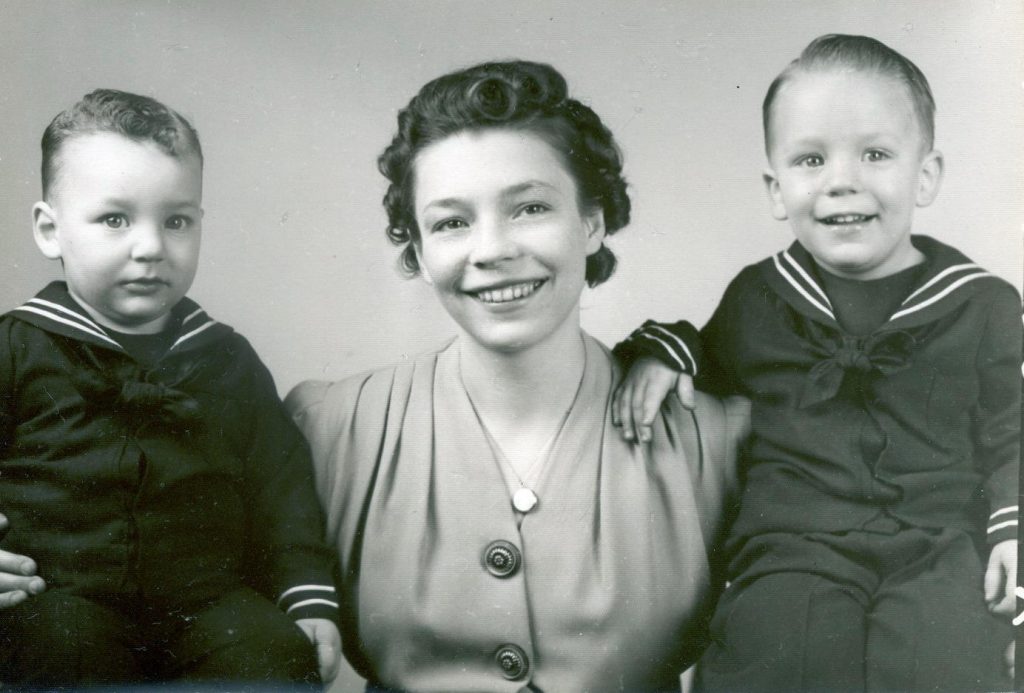
Mom and Sailors 1945

Some background. My dad, George E. Lang Sr., was prime draft age as the United States entered World War II. When he received his draft notice, his employer went to the authorities and told them (truthfully) that his company had contracts to make critical components for the U.S. Navy and without George Lang he wouldn’t be able to fulfill them. As a result, the Draft Board gave dad a deferment.

That deferment lasted through my brother George’s birth in June of 1942, my birth in October of 1943, all of 1944, and on through late spring of 1945. At that point, he received notice to report for induction into the military. Since he would be going overseas in the Army, my mom wanted a photo of herself and the two boys for him take along. Her father, my grandfather Frank Kahles, took her to a studio and had this photo made.

This time, both his company and fate intervened. Just after dad notified his employer of his draft notice, he received a call from a company officer who was in Washington, DC on business. That officer told him emphatically to ignore the notice and not to report. My parents were in a pickle. The company said don’t report, but he could get arrested. What to do??? Two days later, the war was over. Guess that guy knew something but couldn’t say it out loud.